
Yellow Grouper (50 Pesos)
PDFGeneral information

Description
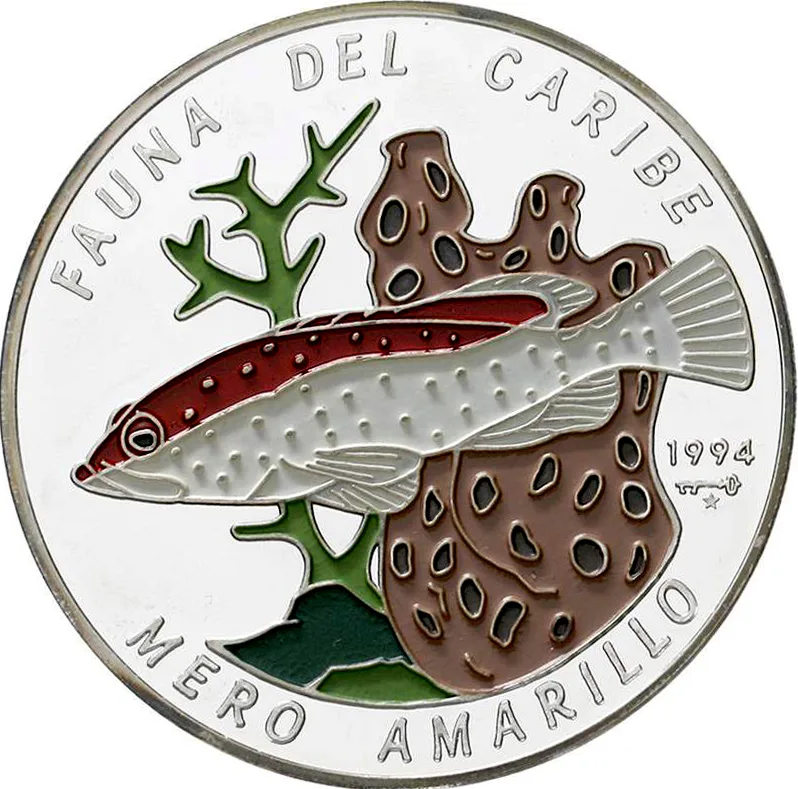
The grouper is a fish that has no "face" in the usual sense but has character: a big head, an enormous mouth and an unruffled gaze. On the largest coin of this design, issued by Cuba in 1994, the yellow grouper swims in front of a coral: FAUNA DEL CARIBE can be read above, the animal's name MERO AMARILLO below, and the year at the right. The designer was Alejandro Ramos Figueredo, who made the flamingo design in the same programme too.
The Spanish mero amarillo means "yellow grouper", the name Cubans use for groupers of the family Serranidae, though some modern classifications place them in Epinephelidae. It is most often linked with Mycteroperca venenosa, also known as mero aleta amarilla, guacamayo, cuna de piedra and arigua and called yellowfin grouper in English. In the Caribbean, however, "yellow mero" also names other fish with yellow fins, for example Hyporthodus flavolimbatus and Mycteroperca interstitialis. The mint does not document the species: the legend is limited to the words MERO AMARILLO, so it is more correct to rely on the Cuban name.
The yellow grouper is a predator of coral and rocky reefs found from about two to one hundred and thirty-seven metres, usually at 5–35 metres, and juveniles grow up in turtle-grass beds. The fish reaches a metre in length and is a formidable animal, with about fifty centimetres usual; maturity comes at 50–63 cm. The species is a protogynous hermaphrodite: individuals begin life as females and some later become males. This means that fishing of large fish, which are most often males, hits the population's ability to reproduce especially hard.
Groupers are a classic example of fish whose fate depends on protection. Their spawning aggregations are predictable, the fish grow slowly, and overfishing quickly leads to decline. Many Caribbean countries introduce seasonal closures and protected zones, and such measures help to preserve the reef's inhabitants, and with them the reef itself, where groupers regulate the numbers of smaller predators.
On a large coin the engraver could show what on smaller ones remains a detail: the scales, the curve of the fins, the texture of the coral behind the fish. Thanks to hand painting, the yellow and orange tones lie differently on every specimen, and this variability is part of the image of a living reef.
The largest coin of the design is also the most expressive: here the grouper looks not like a small drawing but almost a portrait. One need only glance at the broad sweep of the tail and the powerful line of the back to feel how confidently this predator feels in its own environment. As an introduction to the island's reef fauna it is one of the most vivid images.
Obverse
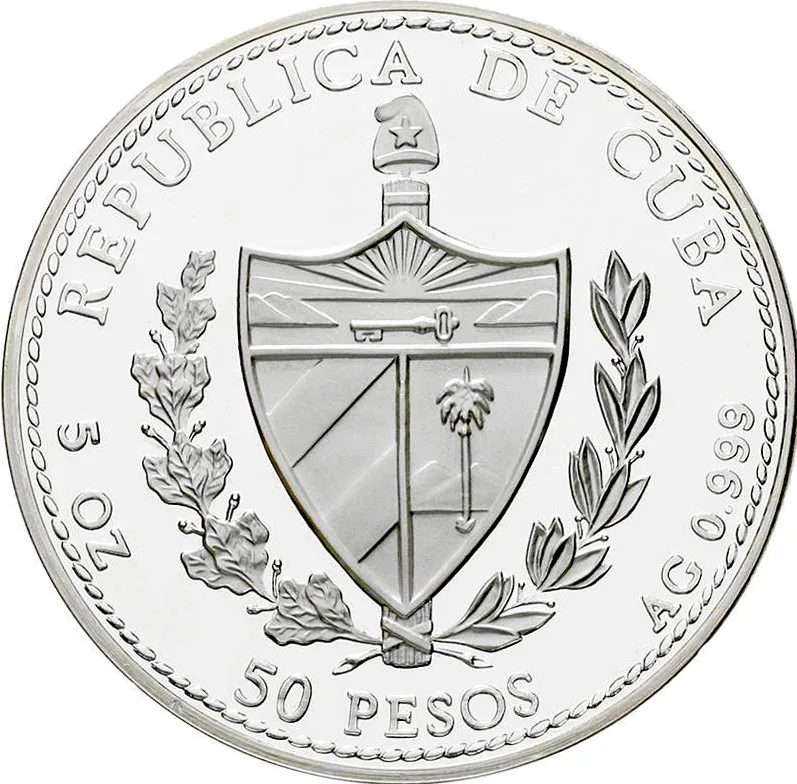
The obverse bears the country's arms, a shield with key, palm, mountains and rising sun among laurel and oak branches; REPUBLICA DE CUBA arcs above and 50 PESOS stands below. The design of this emblem as used on Cuban coins is credited to Charles Edward Barber.
Reverse
A grouper swimming in front of a coral; along the upper arc FAUNA DEL CARIBE, below the animal's name MERO AMARILLO, and at the right the year 1994 and the mark of the mint, Empresa Cubana de Acuñaciones in Havana. The broad field allowed fins and coral texture to be worked in detail; the colour is applied by hand, and the shine of the ground clearly sets off the fish's figure.