
500 Years of the Crown 2026 Cupro-Nickel BU
PDFGeneral information


Description
In August 1526 a coin appeared in England whose name is still alive. Under King Henry VIII the Royal Mint issued a gold “Crown of the Rose”, which passed for four shillings and sixpence. It was the first English coin called a “crown”, and the word proved remarkably durable: by the autumn of the same year it had been replaced by the “Crown of the Double Rose”, struck in 22-carat gold and equal to five shillings, a quarter of a pound.
What was special about this coin is that it bore no royal portrait. Instead of the monarch’s face the mint struck the heraldic double rose of the Tudors — red and white roses joined in one flower. It was a political sign: after the Wars of the Roses the Tudor dynasty grew out of the union of the Lancastrians, whose emblem was the red rose, and the Yorkists, whose emblem was the white one — Henry VII married Elizabeth of York in 1486. Around the edge ran the Latin legend “RUTILANS ROSA SINE SPINA” — “a shining rose without a thorn”. A lovely image: a power that promised its subjects peace without prickles.
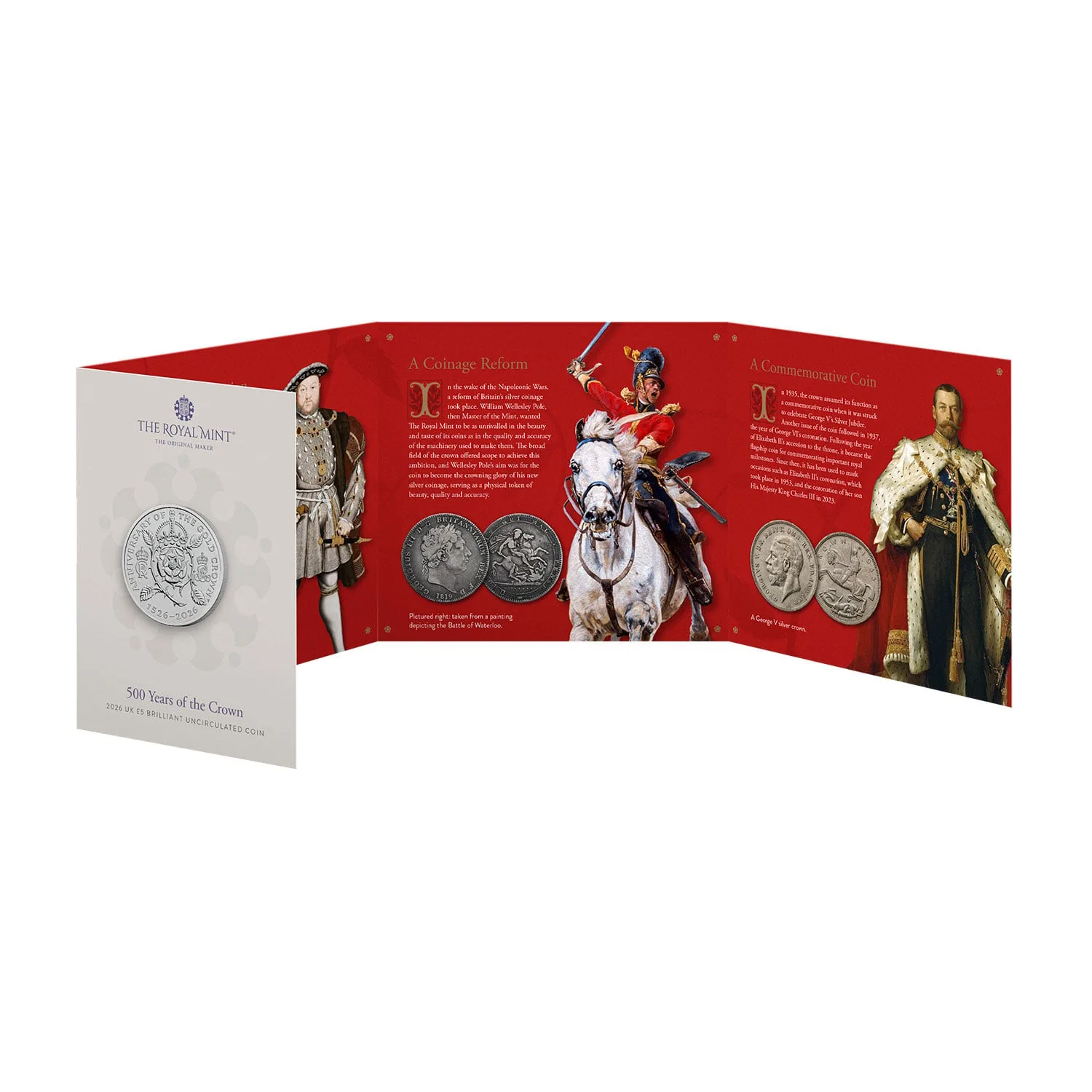
The word “crown” became a long-liver. Gold crowns were struck, with breaks, until 1662; from 1551, under Edward VI, there was a silver crown — a heavy coin that became familiar in reckoning for centuries. Later it left everyday circulation and became commemorative: crowns were struck for coronations, jubilees and great events. Since 1990 the English crown has been worth five pounds sterling. Anyone picking up such a coin today holds a continuation of a line that began in 1526.
The Royal Mint marks the 2026 anniversary with the gold crown specifically: it is five centuries since the gold coin, not the silver one, from which it all began. The design for the issue was created by the medallist Timothy Noad. He did not copy the old model but reimagined it, combining Tudor heraldry with the symbols of today’s monarchy: a crown above a rose, the king’s cyphers and a date that spans five centuries.
The mint that issues this coin is one of the oldest in the world: by its own chronology the Royal Mint traces its history to 886, to the time of Alfred the Great. Today it works at Llantrisant in Wales, and in the Tower, which it left in the 1970s, only traces of the old workshops remain. In such centuries the word “crown” has been in gold, in silver, in cupro-nickel and even in everyday speech: “crown” long meant simply a large coin.
Obverse
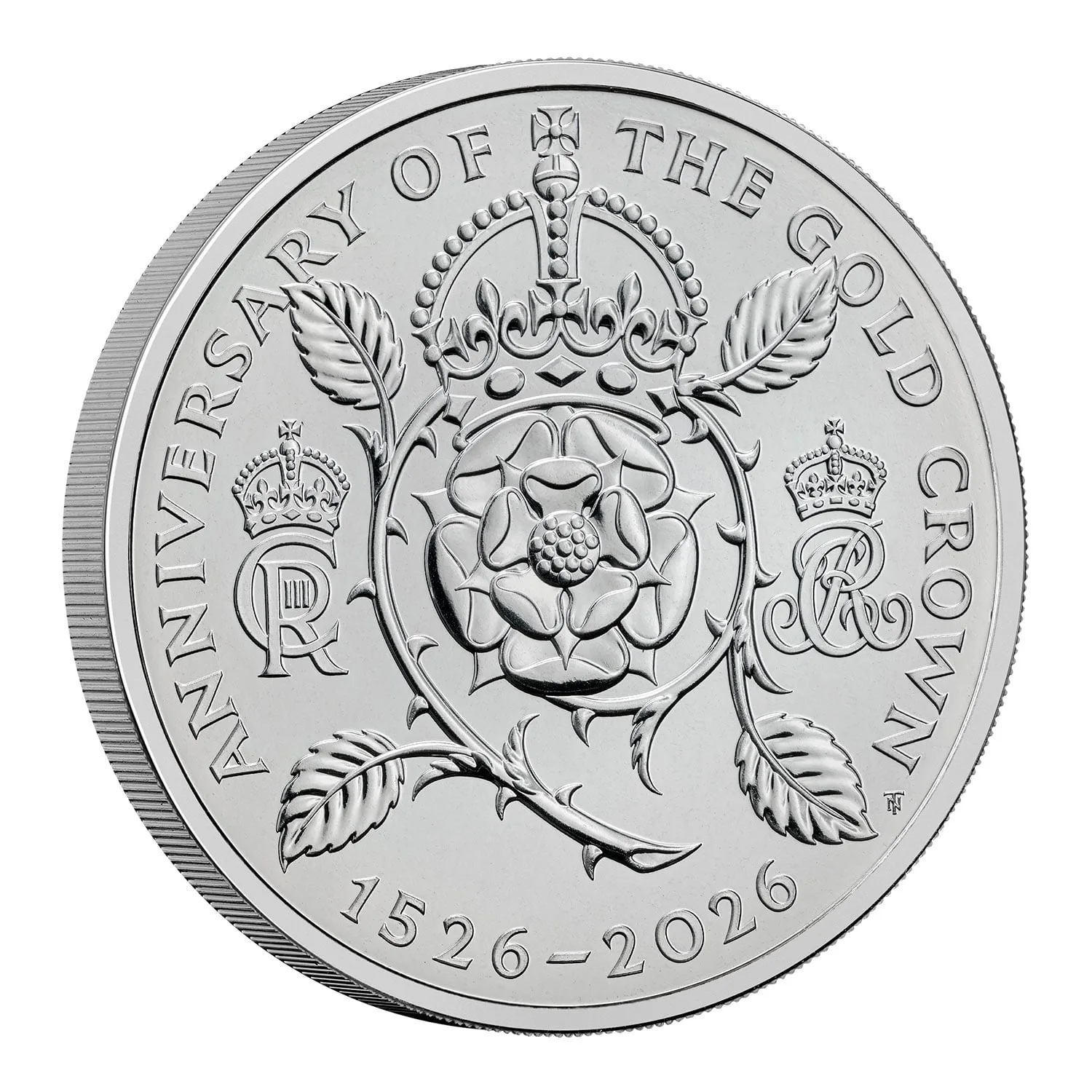
The artistic side is given to the Tudor rose. In the centre is a double rose with a beaded heart, with a royal crown above it. The rose is framed by a curving thorny stem with four large serrated leaves in the corners. On either side stands a crowned royal cypher: on the left the letters C and R with the numeral III, the cypher of Charles III; on the right a second cypher with ornate flourishes. Around the arc runs the legend “ANNIVERSARY OF THE GOLD CROWN”, with the dates “1526–2026” below. The designer’s tiny mark sits near the lower edge. The beaded border is elongated, a reminder of early hand-struck coins.
Reverse
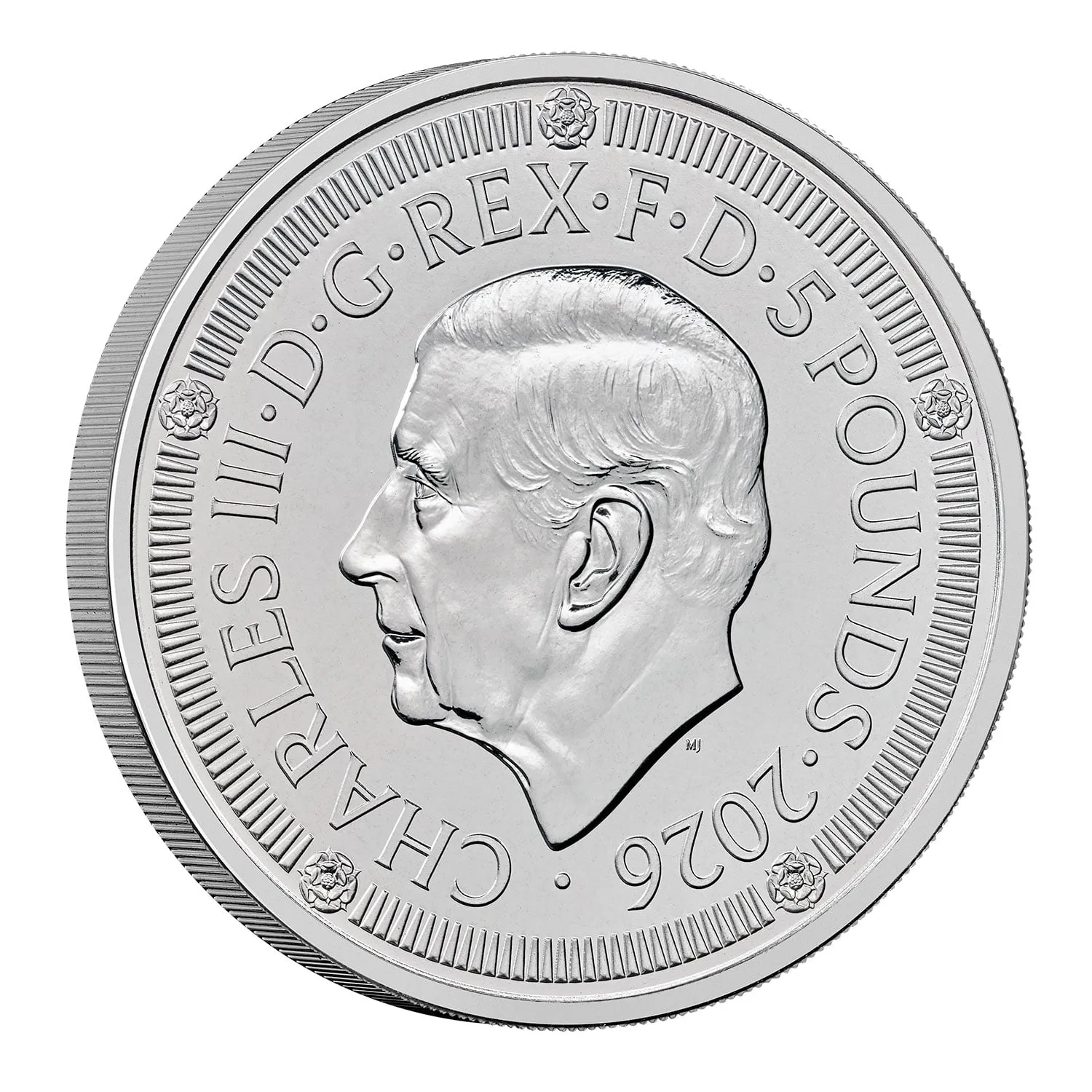
The official side carries a profile portrait of King Charles III by Martin Jennings. The circular legend names the king — “CHARLES III D G REX F D”, “Charles III, by the grace of God king, defender of the faith” — and adds the year 2026. On the outer edge, in a decorative field, are five roses — one for each century since 1526. They are separated by a beaded border, and beside the portrait stands the small monogram “MJ”. This version is the most accessible of the four issues of the same design, for those who want a commemorative crown without precious metal.