
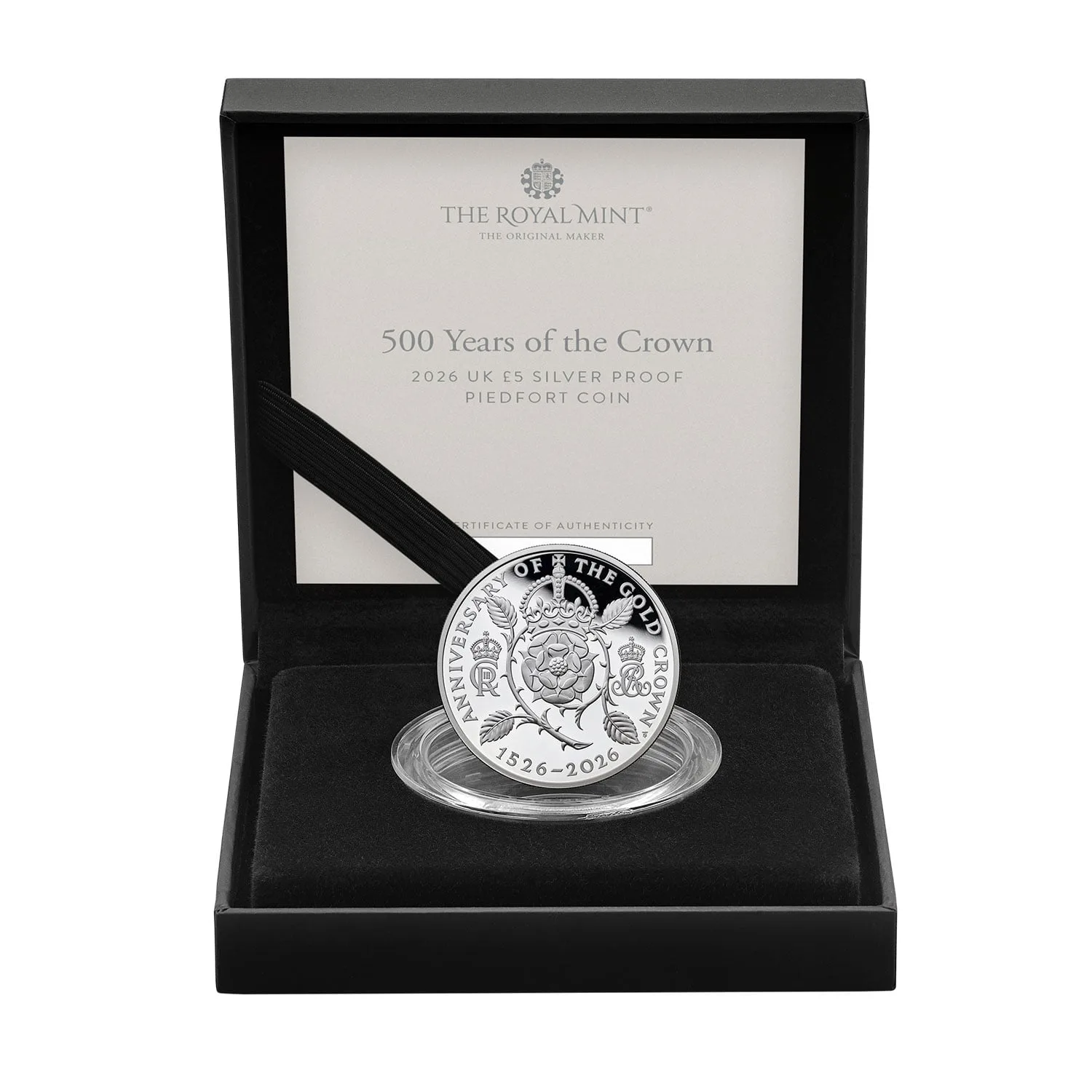
500 Years of the Crown 2026 Silver Proof Piedfort
PDFGeneral information


Description
Henry VIII went down in history as the king of six wives and the break with Rome, but for monetary history he matters also as the monarch under whom the “crown” was born. In 1526 the gold “Crown of the Rose” appeared in his reign, followed by the “Crown of the Double Rose” in 22-carat gold, which passed for five shillings. It had no royal face but did have the double Tudor rose and the Latin legend “RUTILANS ROSA SINE SPINA” — “a shining rose without a thorn”.
That rose is a union of the red rose of Lancaster and the white rose of York. Henry’s father, Henry VII, ended the Wars of the Roses by marrying Elizabeth of York, and the symbol of unity was struck on gold so that subjects would see it every day. A quarter of a century later, in 1551, under Edward VI, a silver crown appeared; gold ones were struck until 1662, and after that the crown remained for a long time silver and commemorative. Today the English crown is worth five pounds.
The present anniversary — 500 years of the gold crown — is marked by an issue in several versions, and the piedfort is a special one among them. “Piedfort” is a word of French origin meaning “heavy foot”: that is what coins struck on a blank of double thickness were called. In the old days such pieces were made as trial strikes or presentation samples, and collectors have always valued them for their massiveness. The modern piedfort keeps the tradition: the same design on thicker metal, and in the hand it feels quite different.
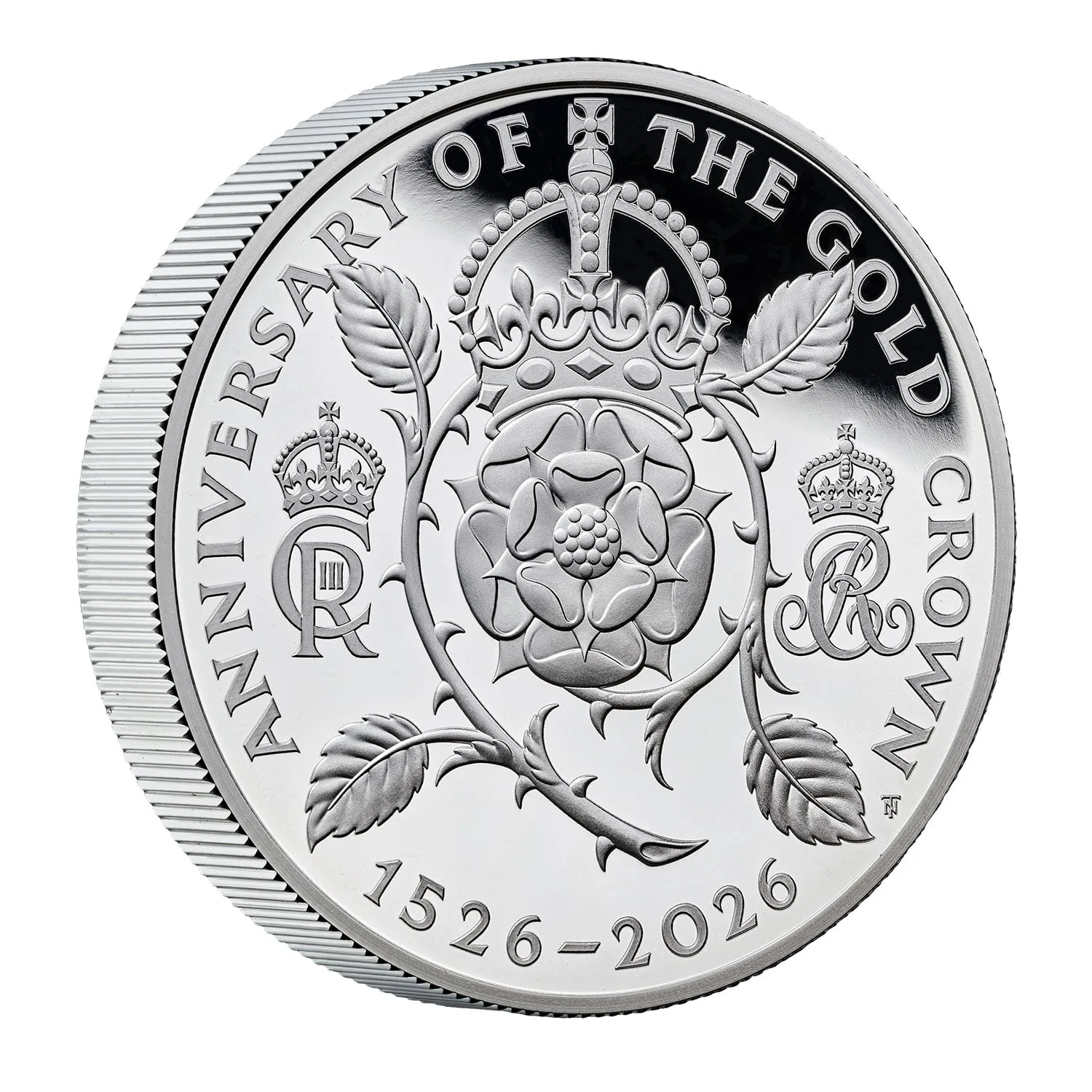
The design of the issue belongs to the medallist Timothy Noad. He reimagined the original composition of 1526, joining the Tudor rose to the cyphers of the present monarch. The five roses on the reverse are five centuries, and the inscription about the anniversary of the gold crown makes clear that what is celebrated is not just a jubilee of a denomination but the memory of a coin of precious gold that gave its name to a whole tradition.
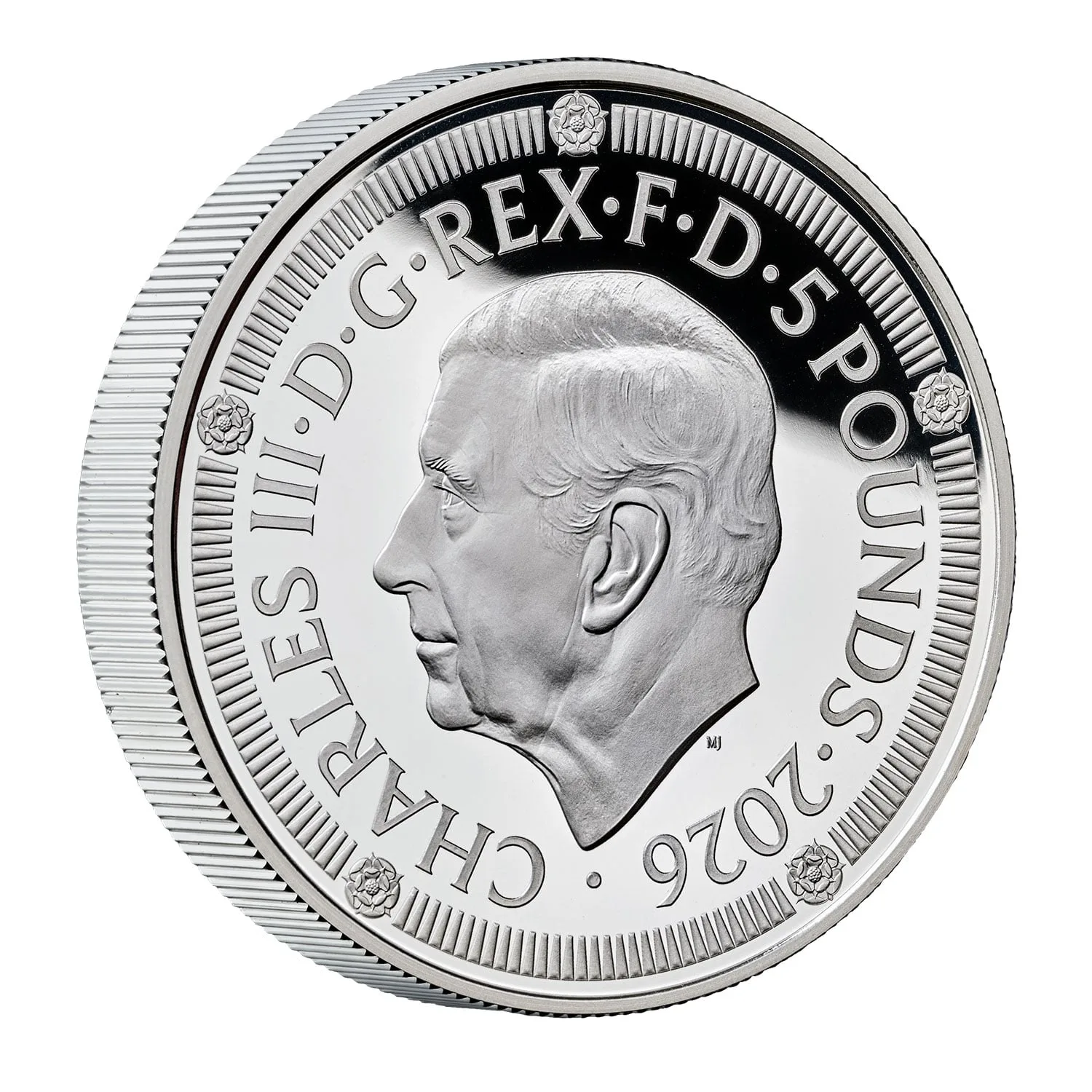
The reverse is graced by a portrait of the present king by Martin Jennings, the sculptor who made the statues of Betjeman and Larkin. Two eras in one issue: Noad returned to the Tudors, Jennings is the portraitist of the present day.
The word “crown” has a less showy side too. Before the “Great Debasement” that began in 1544, Henry VIII issued full-bodied gold; later, to pay for wars, he began diluting the metal. The crowns of 1526 came earlier — in honest money, and the memory of that honesty comes alive in the modern issue.
Obverse
The artistic side is a crowned Tudor rose. A double flower with a beaded heart is topped by a royal crown; around it are a thorny stem and four large leaves in the corners. On either side are crowned cyphers: on the left that of Charles III with the letters C and R, on the right a second cypher with flourishes. The legend “ANNIVERSARY OF THE GOLD CROWN” follows the arc and the years “1526–2026” stand below. The beaded border is elongated, a nod to early hand-striking technique. The mirror field and frosted relief give an especially deep contrast on the thickened blank.
Reverse
The official side shows King Charles III in profile, a portrait by Martin Jennings. Around the portrait is the legend “CHARLES III D G REX F D” and the year 2026. The outer field is decorated with five roses, one per century, with a beaded border running between them. By the portrait at the bottom is the small monogram “MJ”. The relief here is deeper than usual: the thicker blank allows crisp striking to show every feature of the portrait and every petal of the roses.