
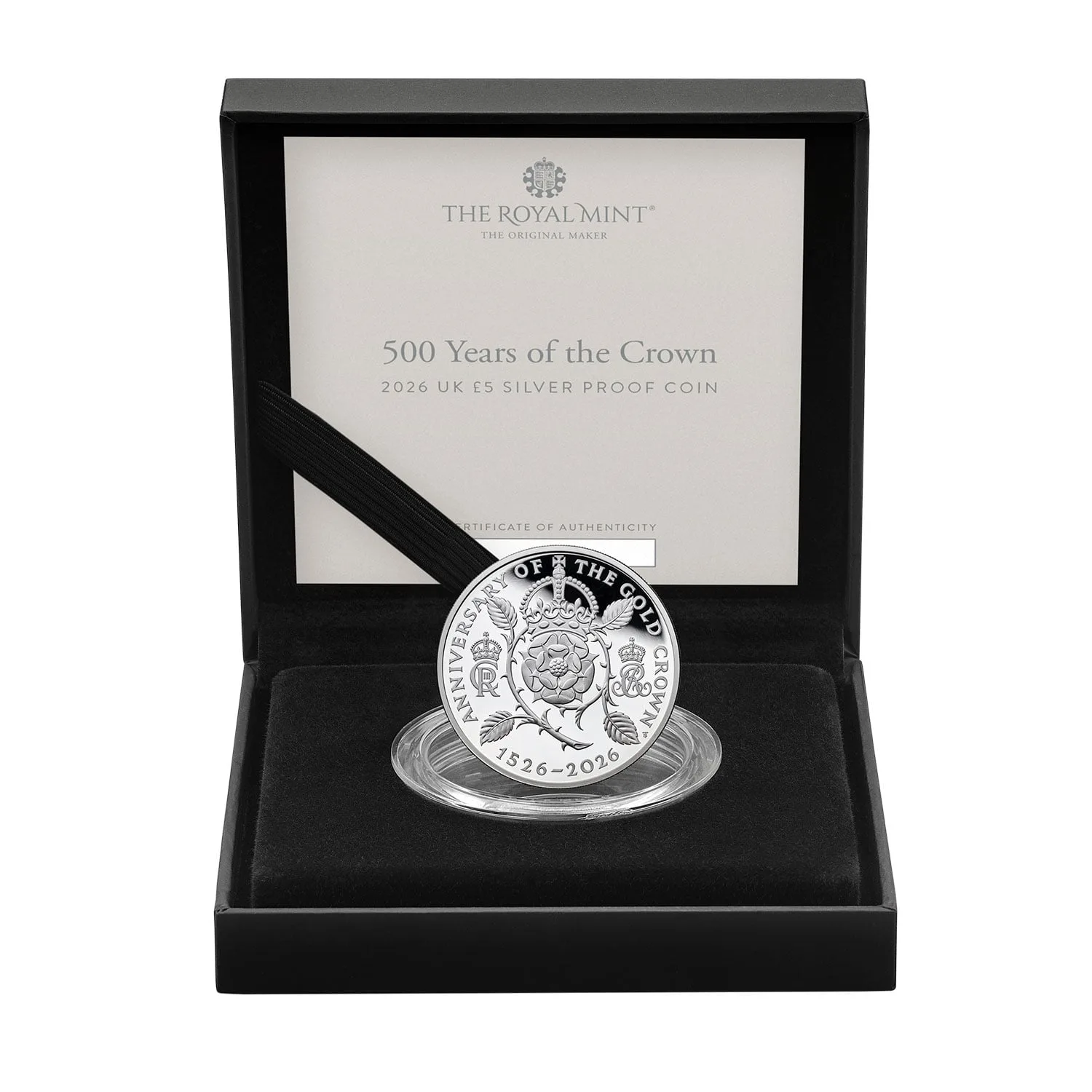
500 Years of the Crown 2026 Silver Proof
PDFGeneral information


Description
The Tudor rose is one of the most recognisable heraldic signs of England, and it has an exact date of birth. When in 1485 Richard III fell on the field of Bosworth and Henry Tudor became King Henry VII, he married Elizabeth of York (1486). That ended the Wars of the Roses between the Lancastrians, whose emblem was the red rose, and the Yorkists, whose emblem was the white. From the joining of the two flowers came the Tudor rose, a double one — red with white — and it became the sign of the new dynasty.
This sign appeared on the first English coin to be called a “crown”. In August 1526, under Henry VIII, the mint issued a gold “Crown of the Rose” at four shillings and sixpence, and in the autumn came the “Crown of the Double Rose” in 22-carat gold, worth five shillings. It had no royal portrait: the front showed the double rose itself with the Latin legend “RUTILANS ROSA SINE SPINA” — “a shining rose without a thorn”.
The word “crown” has had a long fate since. Gold crowns were struck, with breaks, until 1662. In 1551, under Edward VI, a silver crown appeared and for a long time remained the largest silver coin of the country. When large silver left the pocket, crowns survived as commemorative coins — for coronations, jubilees and visits. Since 1990 such a coin has been worth five pounds sterling.
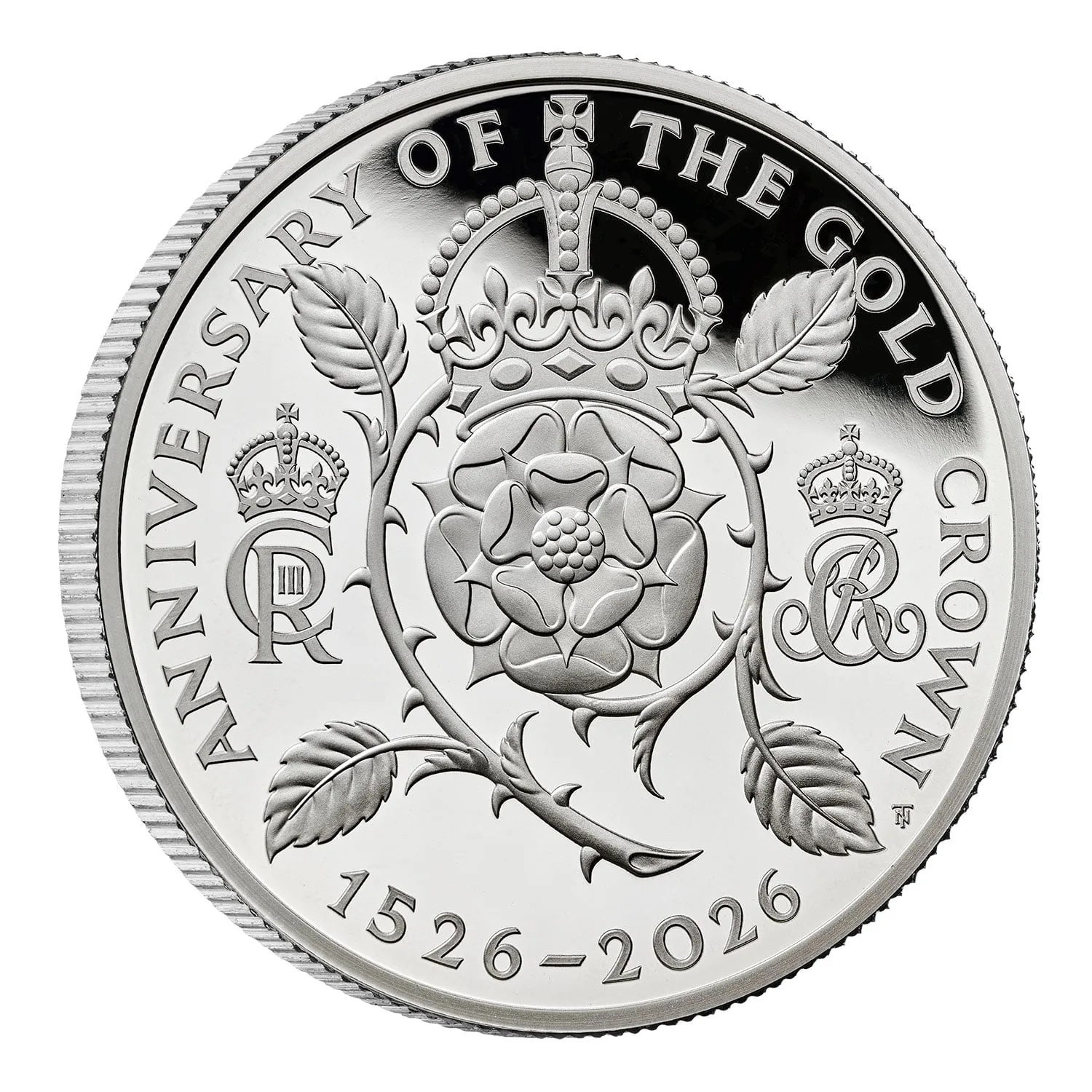
For the five-hundredth anniversary of the gold crown the Royal Mint issued in 2026 a commemorative coin designed by the medallist Timothy Noad. Once again the central rose stands out, but symbols of the present are added: a royal crown and the cyphers of the current king. The old inscription “a shining rose without a thorn” turns into a tale of continuity: five centuries, one crown, one flower.
The gold coin of Henry VIII had a short life. As early as 1544 the “Great Debasement” began: to pay for wars the king started reducing the precious-metal content, and by the end of his reign the silver in the coins was heavily diluted. The crowns of 1526 were issued before that — in gold that needed no excuses. Hence the particular feeling with which the mint returns to them five centuries later.
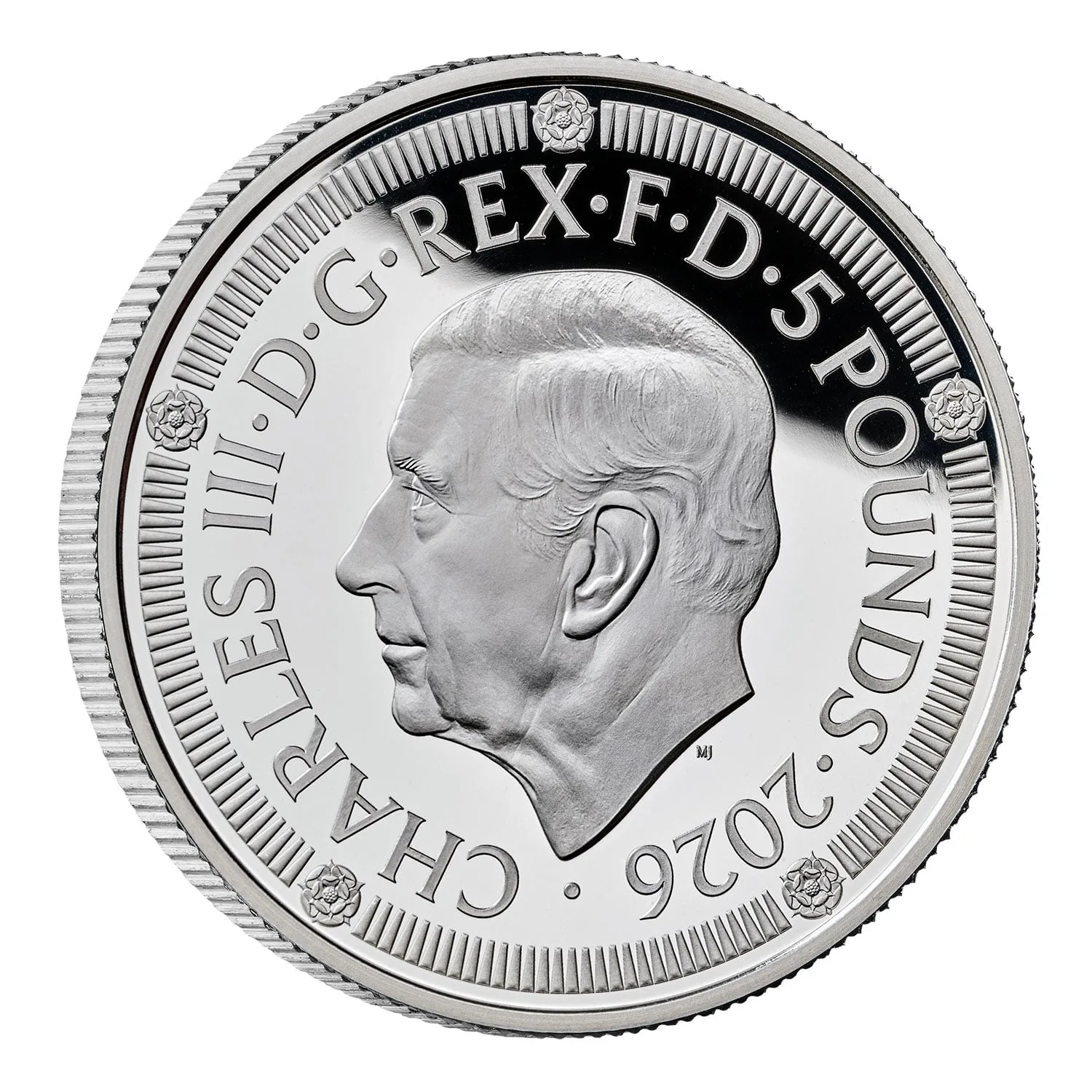
The portrait of the present king on the reverse was made by Martin Jennings, a sculptor known for his statues of John Betjeman and Philip Larkin. His portrait of Charles III became the main one on British coins after 2022. So two masters meet in this issue: Noad, who returned to the Tudors, and Jennings, the portraitist of the present day.
Obverse
On the artistic side is the rose. A double flower with a beaded heart is topped by a Tudor crown with ornaments and a cross on top; a thorny stem winds around it, and in the four corners are large serrated veined leaves. On either side of the rose is a crowned cypher: on the left that of Charles III with the letters C and R, on the right a second cypher with ornate flourishes. The legend “ANNIVERSARY OF THE GOLD CROWN” follows the upper arc, with the dates “1526–2026” below. The designer’s small monogram sits at the lower right edge. The mirror-bright field contrasts with the frosted relief: the rose seems to glow on the smooth metal.
Reverse
The reverse is the official side, a profile portrait of Charles III by Martin Jennings. The king is shown wearing a crown, and around runs the legend “CHARLES III D G REX F D” with the year. The outer field is divided into five parts by roses, one for each century since 1526, with an elongated beaded border between them. Beside the portrait at the bottom is the monogram “MJ”. Here the portrait of today’s king stands next to the emblem of his distant predecessors, and that juxtaposition gives the whole issue its meaning.