
Jaffle Maker
PDFGeneral information

Description
A jaffle is the Australian version of the hot sandwich: two slices of bread with the filling inside and the edges sealed by heated plates, so the filling stays in and the crust turns crisp. According to the Numista catalogue, the appliance was first invented by Ernest Smithers in 1949 and was reimagined by Breville in 1974 into the kitchen fixture Australians know today. Since then the jaffle maker has been a companion of campers, school trips and late suppers: all it needs is a gas ring, a campfire or a power point. This modest appliance became part of national kitchen culture, and the Mint included it among the five best-known inventions of the country. “Bright Ideas” is a Royal Australian Mint collection released on 8 October 2026 in partnership with the newsXpress newsagency network. Five Australian inventions that changed everyday life — the stump jump plough, the jaffle maker, the black box flight recorder, the baby safety capsule and high-speed WLAN technology — each received a $1 coin. A sixth coin, the $2 “Australian Inventions”, gathers all five subjects around a light bulb and works as a circulation coin: it was handed out as change in newsXpress stores and slipped into the folder alongside the five dollars for collectors. The face of the campaign was author and presenter Tim Ross, whose book “What a Ripper!” explores everyday objects that shaped Australia.
This is the most domestic coin of the set: its subject recalls a kitchen table rather than a laboratory. For this reason the Mint’s chief executive Emily Martin mentioned that she had made toasties and used four of the five inventions. The $1 coin is struck by the Royal Australian Mint in aluminium bronze (92% copper, 6% aluminium, 2% nickel) in uncirculated quality. Diameter is 25.0 mm, thickness 2.5 mm and weight 9.0 g. The edge is segmented: seven reeded segments of 11 grooves each alternate with seven shorter plain ones. The coin belongs to the five-coin “Bright Ideas $1 Uncirculated Collection Folder and Five-Coin Set”, limited to 35,000 folders, which the Mint and newsXpress stores offer together with the $2. It is a collector issue carrying the effigy of King Charles III and the year 2026 on the obverse. The collection is sold in several formats. The main one is a folder of five $1 coins with an extra slot for a $2 coin, which is placed into the folder at the point of sale; the number of such sets is limited to 35,000. For collectors who want varieties the Mint produced a seven-coin set in a folding keepsake box in which all coins carry a light bulb privy mark, as well as a $2 proof coin with a mintage of 10,000. In every tenth five-coin $1 set the usual black box is replaced by its coloured version with an orange recorder. The coins are struck at the Mint in Canberra, and the obverse with the portrait of King Charles III by Dan Thorne is common to all denominations of 2026.
Obverse
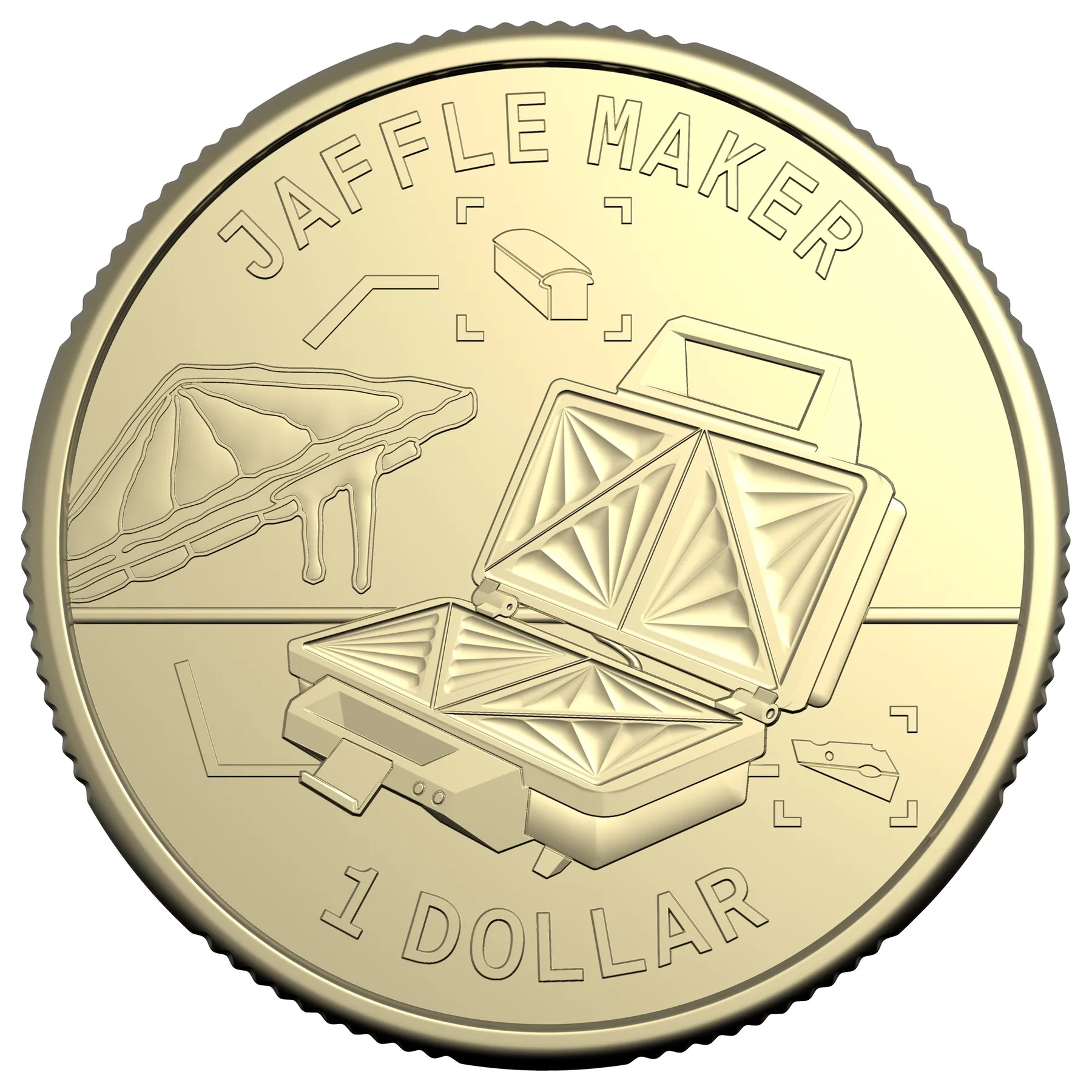
The coin shows a jaffle maker with a toastie to the left and the inscriptions “JAFFLE MAKER” and “1 DOLLAR”. The design is by the Mint artist I. Fong.
Reverse
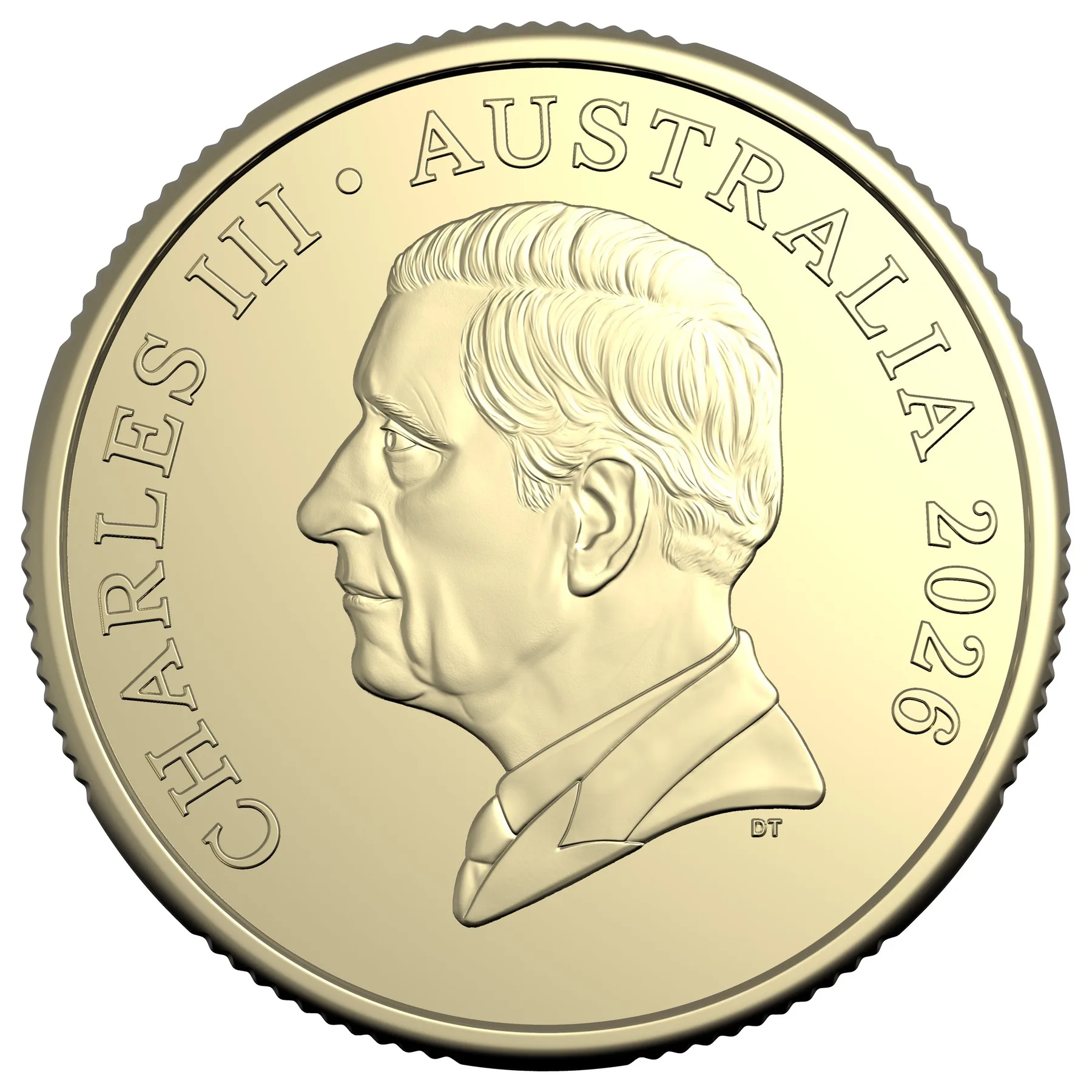
This is the portrait side, the obverse in the Mint’s terminology. It shows an uncrowned portrait of King Charles III facing left, the inscriptions “CHARLES III” and “AUSTRALIA 2026” and the initials “DT” of the portrait designer Dan Thorne.