
Stump Jump Plough
PDFGeneral information

Description
Farmers in nineteenth-century South Australia had to win their land from the mallee, low eucalypt scrub whose stumps and roots hid just below the surface. An ordinary plough that struck such a stump broke, and the field had to be cleared by hand, root by root. A solution came from the South Australian farmer Richard Smith, who patented in 1876 a plough whose shares did not jam against an obstacle but jumped over it and dropped back into the furrow. This simple mechanical idea made it possible to plough uncleared land and opened vast areas to farming where cultivation had been out of the question. The stump jump plough is regarded as one of the symbols of Australian ingenuity, and it leads the Bright Ideas list. “Bright Ideas” is a Royal Australian Mint collection released on 8 October 2026 in partnership with the newsXpress newsagency network. Five Australian inventions that changed everyday life — the stump jump plough, the jaffle maker, the black box flight recorder, the baby safety capsule and high-speed WLAN technology — each received a $1 coin. A sixth coin, the $2 “Australian Inventions”, gathers all five subjects around a light bulb and works as a circulation coin: it was handed out as change in newsXpress stores and slipped into the folder alongside the five dollars for collectors. The face of the campaign was author and presenter Tim Ross, whose book “What a Ripper!” explores everyday objects that shaped Australia.
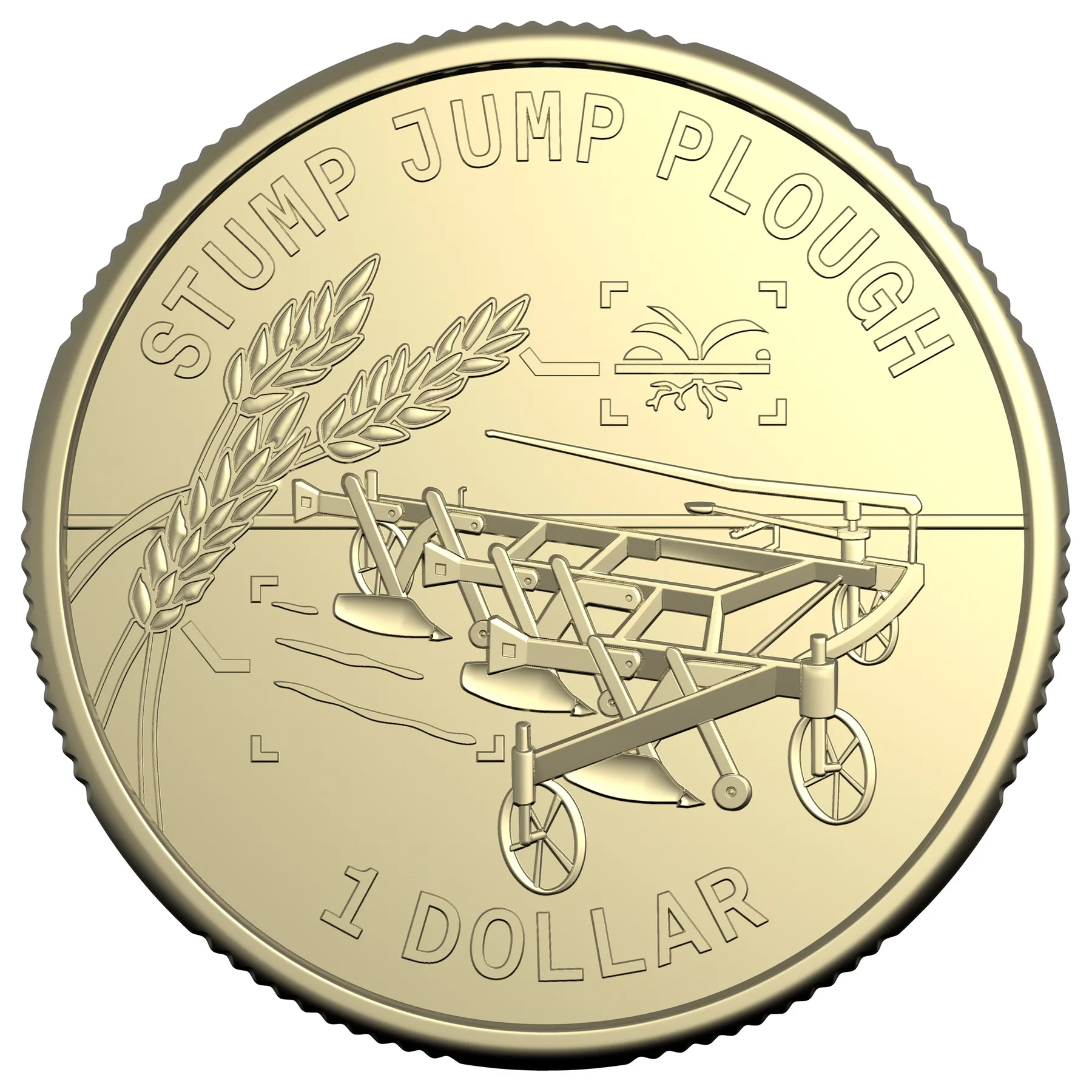
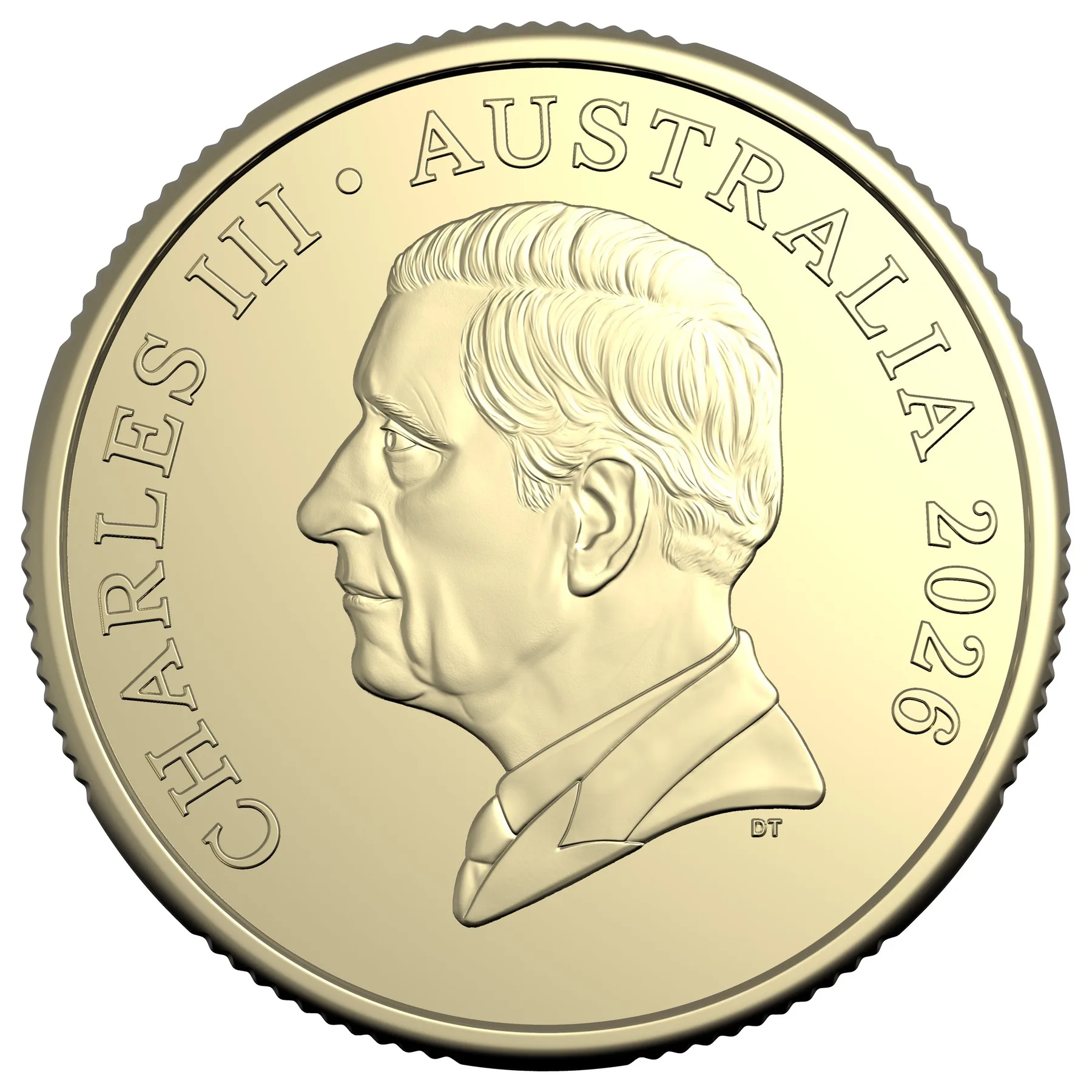
This issue is dedicated to the first invention of the set, an agricultural one. The coin shows a plough and an ear of wheat, the farmer’s labour that made the invention famous; the grain reminds that it was wheat that made clearing the mallee profitable. The $1 coin is struck by the Royal Australian Mint in aluminium bronze (92% copper, 6% aluminium, 2% nickel) in uncirculated quality. Diameter is 25.0 mm, thickness 2.5 mm and weight 9.0 g. The edge is segmented: seven reeded segments of 11 grooves each alternate with seven shorter plain ones. The coin belongs to the five-coin “Bright Ideas $1 Uncirculated Collection Folder and Five-Coin Set”, limited to 35,000 folders, which the Mint and newsXpress stores offer together with the $2. It is a collector issue carrying the effigy of King Charles III and the year 2026 on the obverse. The collection is sold in several formats. The main one is a folder of five $1 coins with an extra slot for a $2 coin, which is placed into the folder at the point of sale; the number of such sets is limited to 35,000. For collectors who want varieties the Mint produced a seven-coin set in a folding keepsake box in which all coins carry a light bulb privy mark, as well as a $2 proof coin with a mintage of 10,000. In every tenth five-coin $1 set the usual black box is replaced by its coloured version with an orange recorder. The coins are struck at the Mint in Canberra, and the obverse with the portrait of King Charles III by Dan Thorne is common to all denominations of 2026.
Obverse
The artistic side shows a stump jump plough behind a sheaf of wheat with the inscriptions “STUMP JUMP PLOUGH” and “1 DOLLAR”. The design is by the Mint artist I. Fong.
Reverse
This is the portrait side, the obverse in the Mint’s terminology. It shows an uncrowned portrait of King Charles III facing left, the inscriptions “CHARLES III” and “AUSTRALIA 2026” and the initials “DT” of the portrait designer Dan Thorne.