
Tula
PDFGeneral information

Description
Tula has long been called the arms capital of Russia. The Tula Arms Plant was founded by decree of Peter the Great in 1712, and since then the city's craftsmen have made muskets, rifles and machine guns. In the Great Patriotic War that tradition became the basis of its defence: Tula produced weapons for the front and itself stood in the enemy's way.
In the autumn of 1941 Guderian's Second Panzer Army, having come through Orel, reached Tula and tried to take the city at a rush and then to bypass it from the south and east in order to reach Moscow. The defence began on 30 October. Units of the Red Army and NKVD troops took the field, but the chief heroes were the workers. From factory collectives, students and schoolchildren a Tula Workers' Regiment and militia detachments were formed; anti-aircraft guns were set for direct fire against tanks. People went out from the shops to the outskirts and returned to their machines, continuing to turn out production.
Guderian could not take Tula and was forced to leave it in his rear, while his overstretched flanks came under attack. In early December 1941 the Red Army went over to the counter-offensive, and the threat to the city was lifted. Tula was never surrendered to the enemy: only the approach to the capital from the south was blocked, while the city and its factories went on supplying the front with arms.
For the mass heroism and courage of its defenders Tula was awarded the title of Hero City in 1976, together with the Order of Lenin and the Gold Star medal.
The defence of Tula rested not only on weapons but on people who knew their city. The gunsmiths knew how to work quickly: when the Germans stood a few dozen kilometres away the shops did not stop, and the plants turned out anti-tank rifles and shells. Even in peacetime the city was known for samovars and spice-cakes, but it was arms that defined its character: one of the oldest arms plants in Russia worked in Tula, and the craftsmen passed on their trade from generation to generation. In 1941 workers' regiments operated in the city, and its inhabitants went out to build fortifications. Today Tula has the obelisk "Hero City Tula" on Victory Square, and the museum of arms holds a rich collection of local work.
Obverse
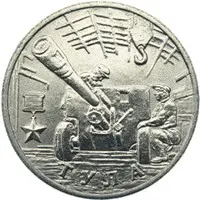
The artistic side: two workers beside a gun in a factory shop, with the Gold Star medal on the left and along the bottom the inscription TULA.
Reverse
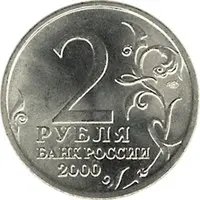
The official side of the coin: the mark of value in two lines, beneath it BANK OF RUSSIA, the year 2000, with stylised branches to right and left.