
Moscow
PDFGeneral information

Description
The Battle of Moscow is one of the most significant battles of the Second World War. At the end of September 1941 the Wehrmacht began Operation Typhoon, whose aim was to seize the Soviet capital before winter. Breaking through the front at Vyazma and Bryansk, the German armies by mid-October reached the areas of Mozhaisk and Volokolamsk; about a hundred kilometres remained to Moscow, and in places fewer. On 19 October a state of siege was declared in the city.
Muscovites built defensive lines, formed militia detachments and fitted out barricades in the streets. Government offices were evacuated, but Stalin stayed in the capital. On 7 November 1941 the traditional parade took place on Red Square: troops marched past the Mausoleum and went straight to the front. Fighting raged near the village of Dubosekovo, where the division of General Ivan Panfilov halted German tanks, and on all the approaches to the city.
On 5–6 December 1941 the counter-offensive of the Red Army began. German troops were thrown back from Moscow by a hundred to two hundred and fifty kilometres, Kalinin and Kaluga were liberated, and the myth of the Wehrmacht's invincibility was dispelled. It was the first major defeat of Hitler's forces, and it wrecked the plan of a "lightning war".
The title of Hero City was conferred on Moscow on 8 May 1965, to mark the twentieth anniversary of the Victory, for the mass heroism, courage and endurance shown by the working people of Moscow in the struggle against the German fascist invaders.
The defence of Moscow was also the common cause of the whole people. In the autumn months of 1941 Muscovites dug hundreds of kilometres of anti-tank ditches and trenches, and on the outskirts steel hedgehogs of rails and barricades were set up. From factory workers, students and office staff twelve divisions of the people's militia were formed, which went to the front not yet fully trained. Metro stations served as air-raid shelters, and on rooftops people stood watch to throw off incendiary bombs. At heavy cost the enemy was stopped on the near approaches: by November fresh Siberian units, brought from the east, stood on the approaches to the city. In those days Georgy Zhukov, commander of the Western Front, directed the defence, and in December, when the counter-offensive began, German armies for the first time in the whole war retreated from occupied positions. The victory at Moscow changed the mood of people in the rear and at the front and gave confidence in the coming victory.
Obverse
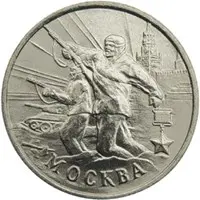
The artistic side shows two infantrymen at the moment of attack, with a tank on the left, the Gold Star medal on the right and, in the background, the outline of the Spasskaya Tower of the Moscow Kremlin. Along the bottom runs the inscription MOSCOW.
Reverse
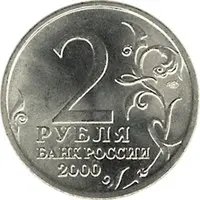
The official side contains the mark of value, the inscription BANK OF RUSSIA, the date and stylised branches at the sides.