
Leningrad
PDFGeneral information

Description
On 8 September 1941 German troops took Shlisselburg and closed the ring around Leningrad. So began a siege that lasted until 27 January 1944, almost nine hundred days. A city of over two million people was left without its usual supplies. In the winter of 1941–1942 the bread ration for workers and dependants fell to the lowest level of the whole siege, and bread was issued in thin slices, and hundreds of thousands of Leningraders died of hunger, cold and shelling.
The only road to the city lay across Lake Ladoga. In winter a route was laid across its ice, which came to be called the Road of Life: the first lorries crossed it in November 1941. The vehicles went in columns under fire and bombing, often broke through the ice, and the drivers drove with their doors open so as to be able to jump out. The road brought food and ammunition into the city and carried children, women and the wounded out. In the course of the siege more than a million people were evacuated from Leningrad.
The city did not merely survive, it worked. Factories turned out shells and tanks, and on 9 August 1942, in besieged Leningrad, Shostakovich's Seventh Symphony was performed under Karl Eliasberg: the musicians of the Radio Committee, many of them emaciated, played it while loudspeakers carried the sound across the city and over the front line. In January 1943 a narrow corridor to the mainland was broken through, and the siege was lifted completely on 27 January 1944.
Leningrad was awarded the title of Hero City by a statute approved on 8 May 1965, for mass heroism and courage shown by its defenders in the struggle for the freedom and independence of the Motherland. The city had been named among the first in the order of the Supreme Commander on 1 May 1945.
Leningrad's siege left pages in the city's history that are hard to read without emotion. Staff of the All-Union Institute of Plant Industry, in the centre of Leningrad, preserved their collection of seeds, the basis of future breeding work: several of them died of exhaustion without touching the grain they guarded. As early as the summer of 1941 the Hermitage had sent the main part of its treasures away for safekeeping, and those who stayed in the museum hid in its cellars everything that could not be removed. A schoolgirl, Tanya Savicheva, kept a small diary with brief entries about the deaths of her family; it became one of the best-known documents of the siege. At the Piskaryovskoye Memorial Cemetery lie hundreds of thousands of the city's inhabitants who died in those months. In January 1943, in Operation Iskra, the ring was broken, and on 27 January 1944 Leningrad saluted its liberation with twenty-four artillery volleys.
Obverse
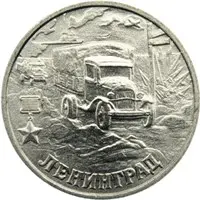
The artistic side shows two lorries driving across the ice of the Road of Life, with the Gold Star medal on the left and on the right a road sign, a fountain of water and shards of ice from a burst shell. In the background rises the outline of the Admiralty spire; along the bottom runs the inscription LENINGRAD.
Reverse
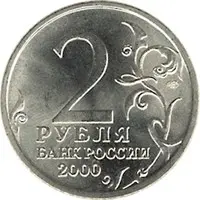
The official side bears the mark of value, the inscription BANK OF RUSSIA, the year 2000 and stylised branches of a plant at the sides.