
Sevastopol
PDFGeneral information

Description
The defence of Sevastopol in 1941–1942 entered military history as a model of long and active defence of a seaside city and the main base of a fleet, left deep behind the enemy's lines. The Germans made their first attempt to take the city on 30 October 1941: a garrison of about twenty-three thousand men with a hundred and fifty guns beat it off. It was followed by three more assaults: in November, when four infantry divisions tried for ten days in vain to break through to the city, and in December, which cost the enemy, by estimate, up to forty thousand men.
The decisive offensive began in June 1942. Enormous forces were brought up to Sevastopol: two hundred thousand men, four hundred and fifty tanks, more than two thousand guns and mortars, about six hundred aircraft, and also super-heavy siege artillery. The enemy blockaded the city from the air, stepped up operations at sea and went over to the offensive on 7 June. The defenders held for twenty-five days and nights of assault and about two hundred and fifty days of defence in all. On 4 July 1942 Soviet troops were forced to leave Sevastopol, but having tied down large forces and inflicted heavy losses on them, they thwarted the plans of the command on the southern flank of the front.
The occupation was brutal. Liberation came in May 1944, when Soviet troops, storming Sapun Ridge, broke through the defences, and on 9 May the city became Soviet again. Sevastopol was named among the first hero cities in the order of 1 May 1945, and the title of "Hero City" was confirmed for it in 1965.
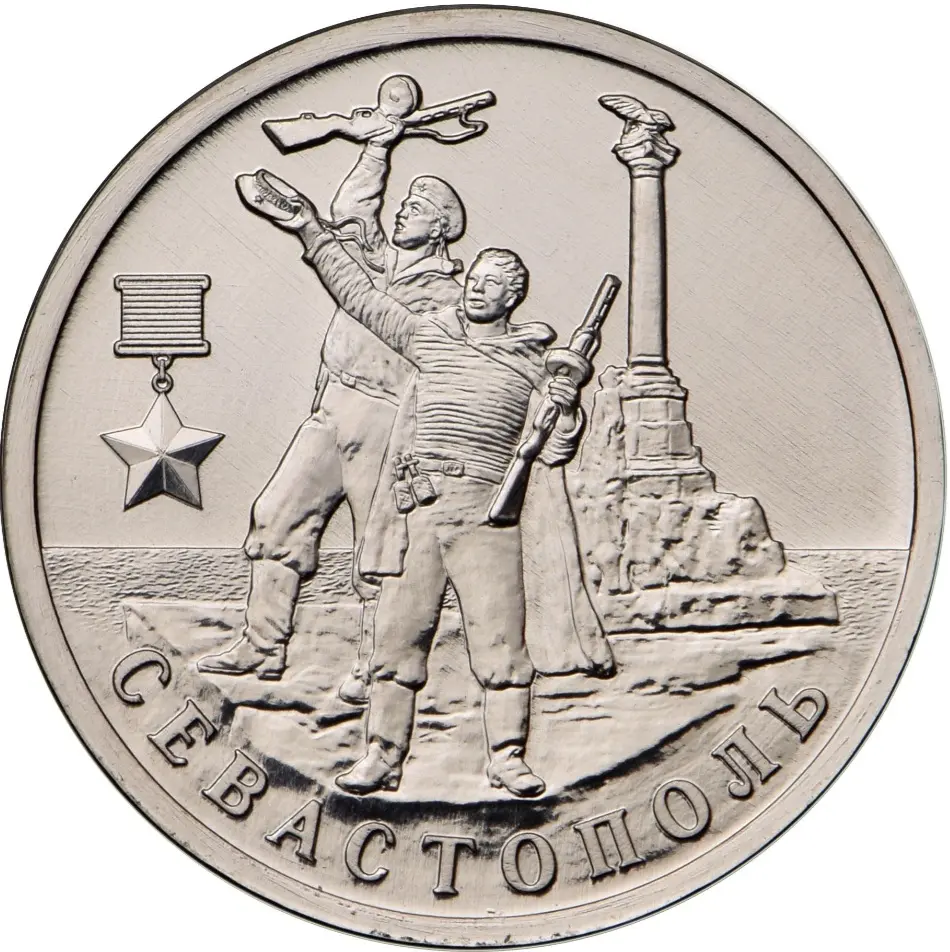
The Monument to the Scuttled Ships, standing in the water at the entrance to Sevastopol Bay, was unveiled in 1905 in memory of the defence of Sevastopol in the Crimean War of 1854–1855. It has become a symbol of the city's military glory, and it is against its background that the sailors on the coin are shown.
For Sevastopol 1942 was the second defence in its history, after that of 1854–1855. Then, in the Crimean War, the city stood against Anglo-French forces for almost a year, 349 days, and the heroes of that defence were Admirals Kornilov, Nakhimov and Istomin, while Leo Tolstoy, who served in Sevastopol, wrote his Sevastopol Sketches. In 1941–1942 the city was defended by the Coastal Army, the sailors of the Black Sea Fleet and the inhabitants; heavy guns stood in the coastal batteries, and at night ships brought reinforcements and ammunition to the besieged city and took out the wounded. In the last days of the defence the remnants of the garrison fought at Cape Chersonese, where some of the men put to sea in boats and others went on fighting to the end. The liberation of 1944 began with the storming of Sapun Ridge, where a memorial and a diorama now stand.
Obverse
The artistic side is a relief depiction of figures of sailors against the Monument to the Scuttled Ships; on the left is the Gold Star medal, and along the rim at the bottom the inscription SEVASTOPOL.
Reverse
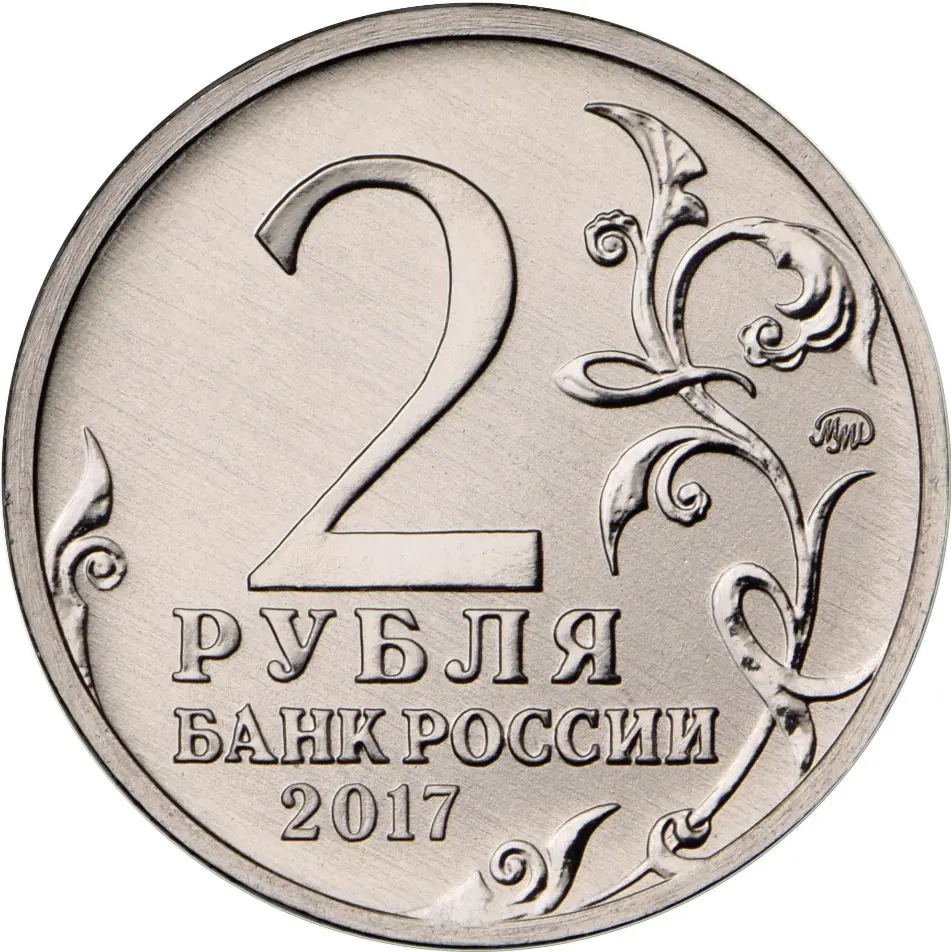
The official side of the coin: the mark of value in two lines, below it BANK OF RUSSIA, the year 2017, stylised branches right and left and, at the rim on the right, the mint's mark.