
Moscow
PDFGeneral information

Description
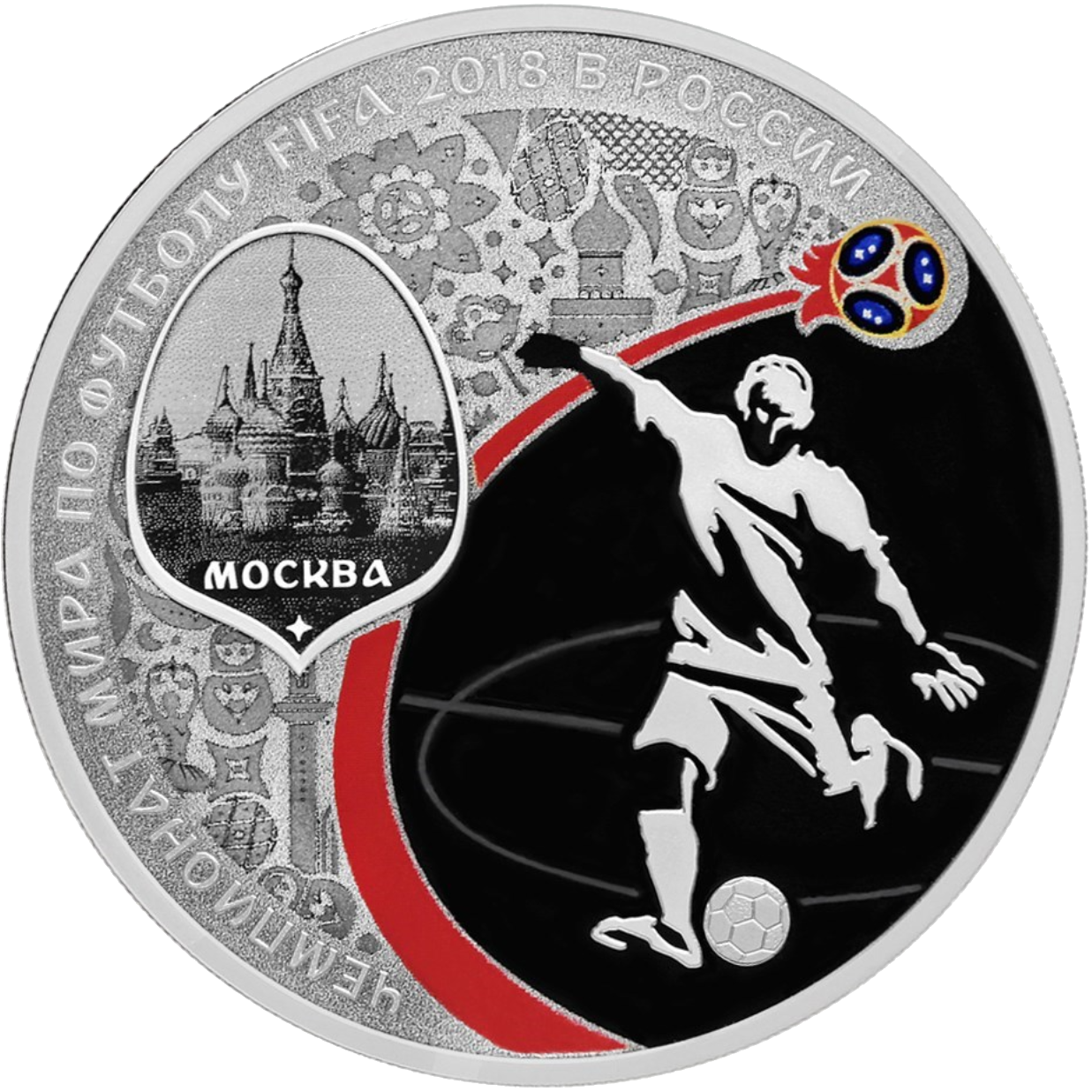
The landmark on the coin is St Basil's Cathedral on Red Square. Its official name is the Cathedral of the Intercession of the Most Holy Mother of God on the Moat, and it was raised in 1555–1561 on the order of Ivan the Terrible to commemorate the conquest of Kazan. Around a central tent-roofed church stand smaller chapels, each topped by its own dome; no two domes share the same pattern, which is why the whole ensemble looks like a fairy-tale town of gingerbread towers. The popular name comes from Basil the Blessed, a holy fool buried by its walls. Beside it on the coin rises the Spasskaya Tower, the main gate of the Kremlin: its tented top was added in the seventeenth century, and its chiming clock became the voice of the country on New Year's Eve.
Moscow first appears in a chronicle in 1147, and at the end of the fifteenth century, under Ivan III, it became the capital of the unified Russian state. The Kremlin and Red Square have been on the UNESCO World Heritage List since 1990. For foreign guests of the championship this ensemble was the first image of Russia, the picture fans photographed and took home. The designers chose it as the calling card of the capital and left modern districts in the background.
The main arena of the tournament stood in Luzhniki. On 14 June 2018 the opening ceremony and the first match took place there: Russia beat Saudi Arabia 5:0. On 1 July the hosts defeated Spain on penalties on the same pitch and reached the quarter-finals, and on 15 July the final was played in Moscow, with France beating Croatia 4:2. The commemorative coin shows the capital not through a stadium but through a cathedral and a tower, the symbols that millions of fans saw during the weeks of the tournament.
Moscow played the role of the main city of the tournament: the opening and the final, two stadiums and the headquarters of the organisers were all here. When in 2010 in Zurich the FIFA Executive Committee voted to give Russia the right to host the championship, the country beat the bid of England and the joint bids of Spain with Portugal and of Belgium with the Netherlands. For Moscow this meant a large-scale renewal: new hotels, metro lines and road junctions, the reconstruction of Luzhniki and the construction of the Spartak stadium. For the coin the artists chose the best-known view of the capital and set it against an ornament in which Russian patterns are interwoven with football symbols, just as the tournament looked on the posters of the city.
Obverse
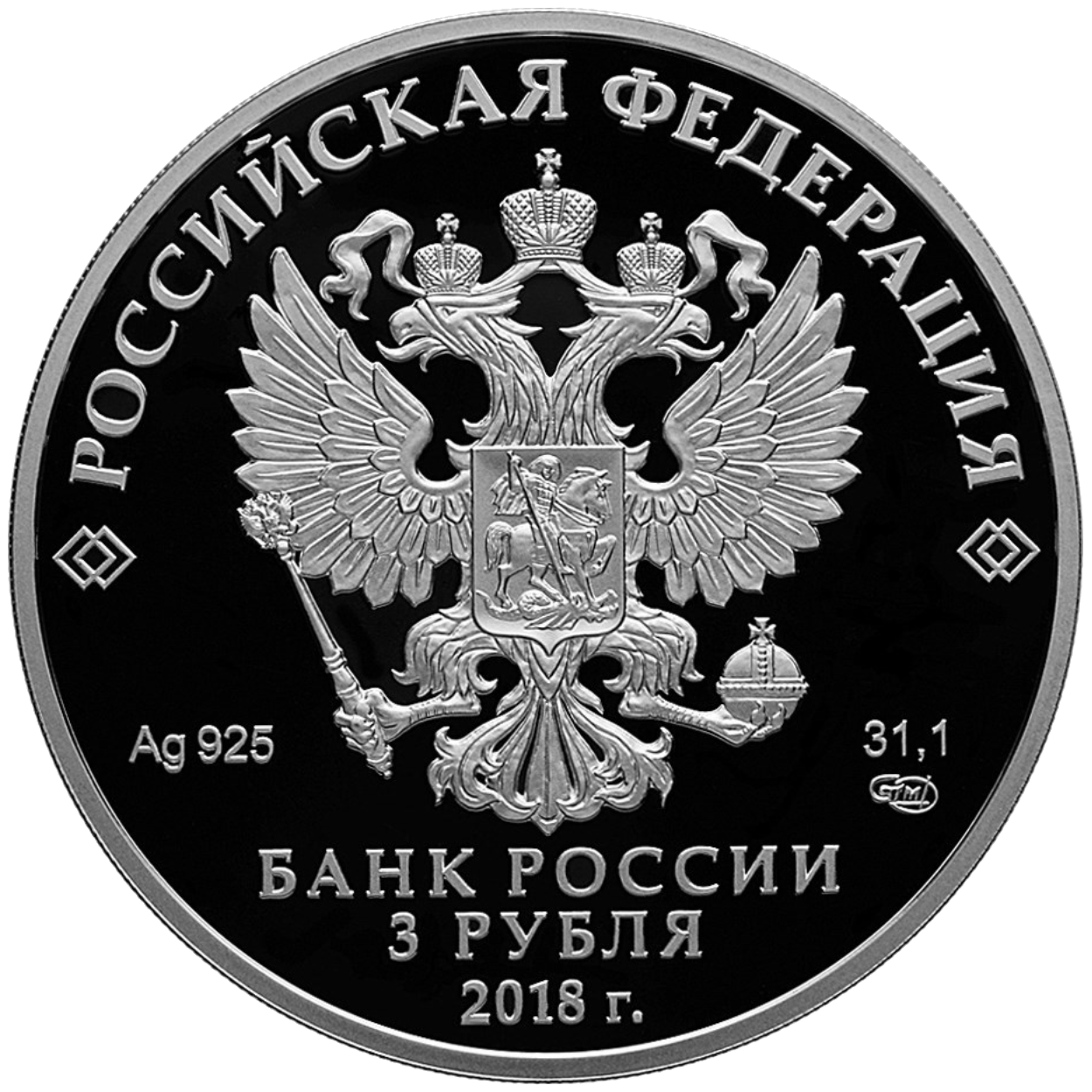
On the mirror field of the disc — the relief image of the State Emblem of the Russian Federation with the double-headed eagle. Above the emblem, along the rim, runs the inscription RUSSIAN FEDERATION (РОССИЙСКАЯ ФЕДЕРАЦИЯ), framed on both sides by paired rhombuses. In the lower part, in three lines, is struck BANK OF RUSSIA, with the denomination and the year of issue shown, and beside the arms the trademark of the mint is visible. The obverse was designed by the artist E. V. Kramskaya and sculpted by A. A. Dolgopolova.
Reverse
The reverse shows a cartouche with St Basil's Cathedral and the Spasskaya Tower of the Kremlin, with the name of the city, MOSKVA, below. The cartouche is set against an ornament that joins Russian cultural and folklore heritage to the world of football. A ball's trajectory executed in colour crosses the composition, and behind it the silhouette of a footballer is seen. Along the edge one reads CHEMPIONAT MIRA PO FUTBOLU FIFA 2018 V ROSSII. The reverse was designed by A. A. Brynza; its relief was produced by computer modelling.