
Ekaterinburg
PDFGeneral information

Description
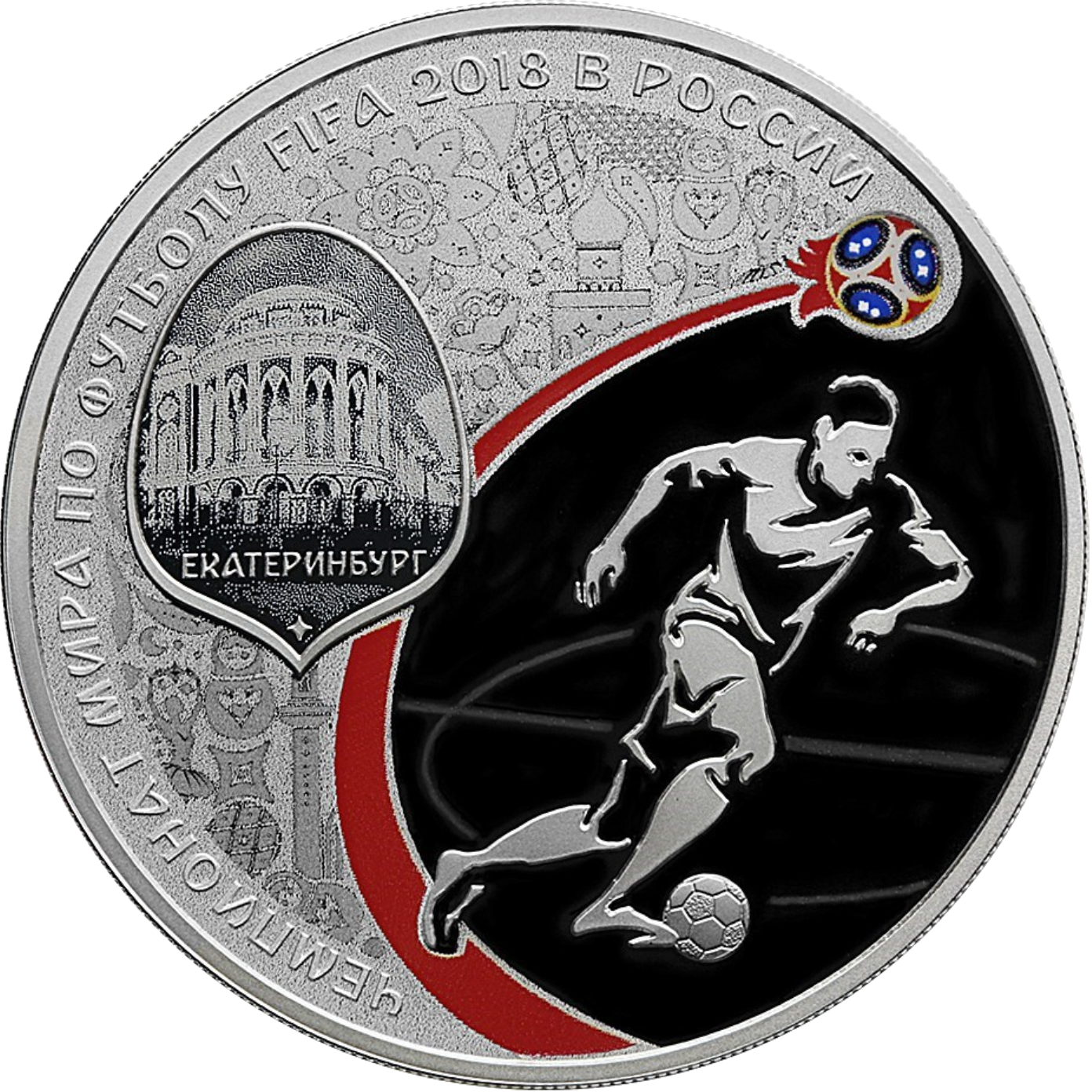
Yekaterinburg on the coin is represented by Sevastyanov's House, one of the most unusual buildings of the Urals. The mansion on the bank of the city pond, by the dam, is known by the name of the entrepreneur Nikolai Sevastyanov, who bought it in 1860. In 1866, on his order, the architect Alexander Paduchev remodelled the facades, combining motifs of baroque and neo-Gothic, and the result was an almost fairy-tale mansion with quaint turrets and carved decoration, which locals love for its ornateness and unusual green colour.
The city was founded in 1723 as a state ironworks and fortress: by order of Peter the Great, Vasily Tatishchev and Georg Wilhelm de Gennin built a dam and a factory on the Iset River and named the place after Empress Catherine I. Yekaterinburg became the centre of the mining Urals and lies not far from the conventional boundary between Europe and Asia, where a memorial marker stands. From 1924 to 1991 the city was called Sverdlovsk.
The Central Stadium of Yekaterinburg was rebuilt for the championship: the historic facade was preserved and the stands were moved outside its walls. Here Uruguay beat Egypt 1:0, France beat Peru 1:0, Japan drew 2:2 with Senegal, and Sweden routed Mexico 3:0. Yekaterinburg turned out to be the easternmost host city, and Sevastyanov's House on the coin shows its face, Uralian and individual.
Yekaterinburg turned out to be the easternmost host city and Kaliningrad the westernmost; between them lies a three-hour time difference, so fans travelled around the country on free night trains and planes. For those who watched matches in the Ural capital the championship coincided with the light nights of the northern summer: the nights were short, and the games were played in the evening. Yekaterinburg is known for rock music, constructivist architecture and industrial heritage. The coin with Sevastyanov's House adds to this image a romantic, almost fairy-tale note.
The Iset flows beside the house, and it was here at the dam that the history of Yekaterinburg began. If one looks at the coin carefully one sees how the small details of the facade are turned by the die into a play of light and shadow: carved lace, turrets, windows.
Beside Sevastyanov's House, on the embankment of the city pond, fans from dozens of countries strolled during the championship. Many of them learned for the first time that the Urals are not only an industrial region but also a land with a rich architectural history.
Obverse
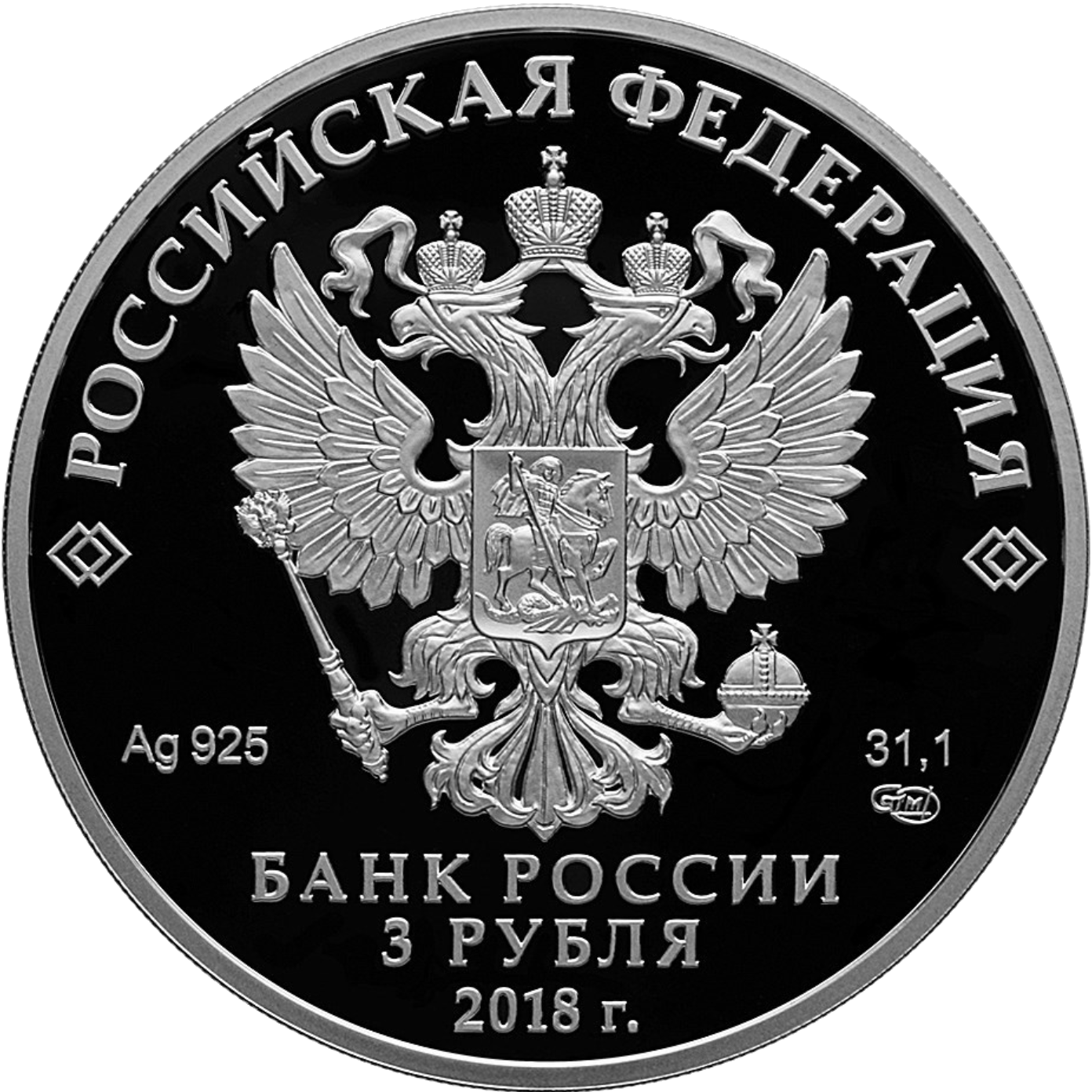
On the obverse on the mirror field of the disc sits the relief coat of arms of the Russian Federation with its double-headed eagle. Above the emblem, along the rim, runs the inscription RUSSIAN FEDERATION (РОССИЙСКАЯ ФЕДЕРАЦИЯ), framed on both sides by paired rhombuses. Beneath the arms the institution that issued the coin is named, BANK OF RUSSIA, in three lines; the denomination, the year and the mint mark are given there as well. The artist E. V. Kramskaya and the sculptor A. A. Dolgopolova worked on the obverse.
Reverse
The reverse presents a cartouche with the house of N. I. Sevastyanov and the name EKATERINBURG. The background is made of folk patterns and football motifs. A bright coloured arc, the trace of a flying ball, divides the cartouche from the player. The inscription CHEMPIONAT MIRA PO FUTBOLU FIFA 2018 V ROSSII (FIFA World Cup 2018 in Russia) runs around the circumference. A. A. Brynza drew the reverse, and the relief was made by computer modelling.