
Saint-Petersburg
PDFGeneral information

Description
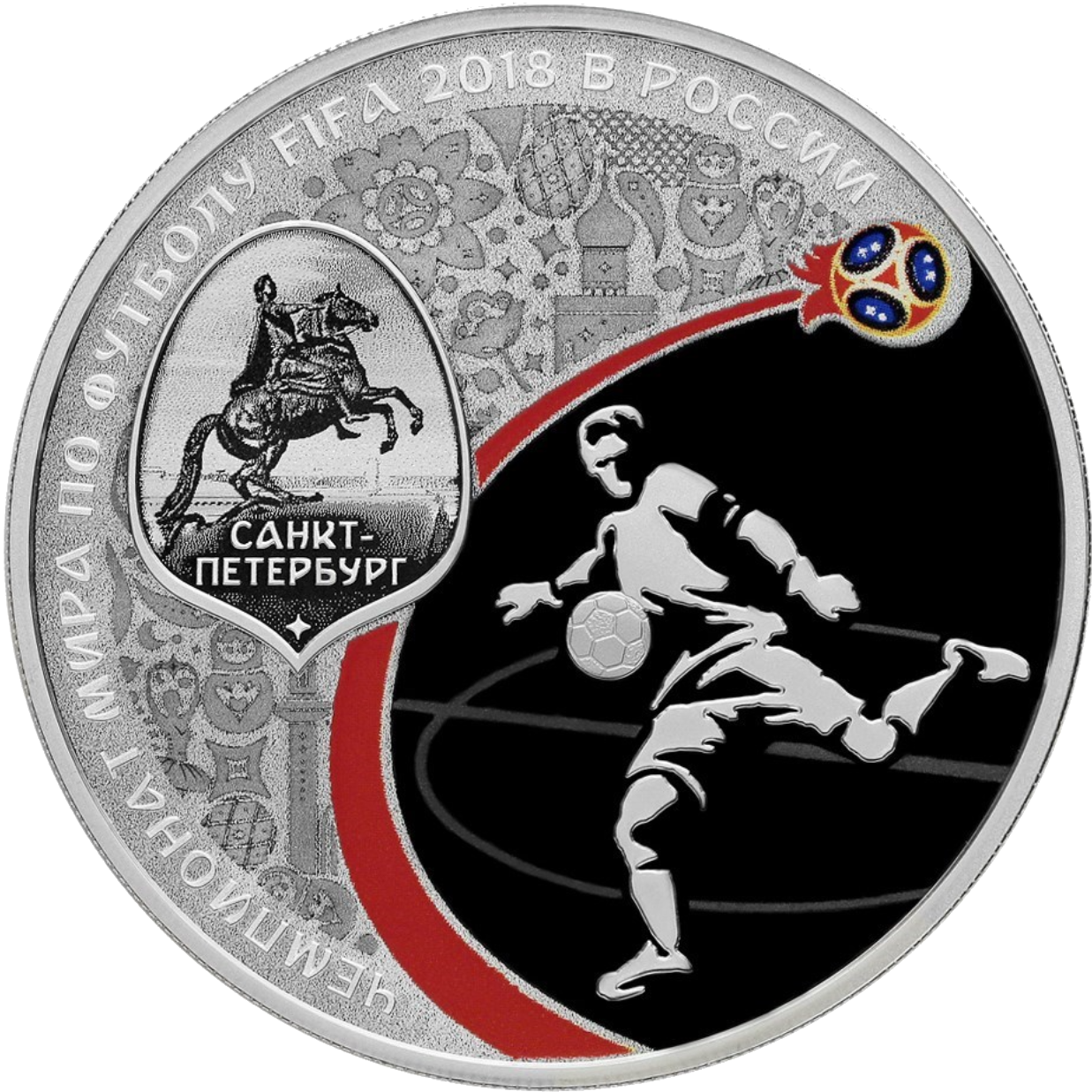
On this coin Saint Petersburg is represented by the monument to Peter the Great, the famous Bronze Horseman. It was created by the French sculptor Étienne Maurice Falconet on the commission of Catherine the Great; the head of the emperor was modelled by his pupil Marie-Anne Collot, and the serpent beneath the horse's hooves was cast by the Russian craftsman Fyodor Gordeyev. Instead of an ordinary pedestal there is a huge granite rock, known as the Thunder Stone, brought to the Neva from the neighbourhood of Lakhta, and its transport was an engineering event of its day. The monument was unveiled in August 1782, and the laconic inscription on it reads: To Peter the First, Catherine the Second. The rider rearing his horse above the bank of the Neva embodies the idea of a ruler who turned Russia towards the sea.
The monument owes its popular name to Alexander Pushkin's poem The Bronze Horseman of 1833; after it the statue became not only a symbol of the city but also a hero of literature. Peter founded the city in 1703 on Hare Island, and from 1712 to 1918 Saint Petersburg remained the capital of the empire. Here Russia learned to build a fleet, keep a window open to Europe and trade across the Baltic. The historic centre is on the UNESCO World Heritage List, and for fans the Northern Capital became a place they wanted to visit between matches.
The arena on Krestovsky Island hosted the opening match of the 2017 Confederations Cup and its final. In 2018 it saw Russia against Egypt (3:1), Brazil against Costa Rica, Argentina against Nigeria, and in July a semi-final between France and Belgium (1:0) and the third-place match in which Belgium beat England 2:0. The monument to Peter on the coin is a reminder that the football festival was held in a city whose history has always looked out over the water.
The 2018 championship also entered history as a tournament of innovations. For the first time at a World Cup the referees were helped by the VAR video review system, so disputed incidents were examined on replay rather than by eye. For fans, free trains between the host cities were organised, along with a Fan ID that let people enter the country without a visa for the duration of the tournament. The main ball of the tournament, the Telstar 18, repeated the design of the famous ball of the 1970 championship. Saint Petersburg, where all this was also in place, became one of the most decorated cities: fan festivals worked on the Neva embankment, Palace Square and Nevsky Prospect, and the city greeted guests with its White Nights.
Obverse
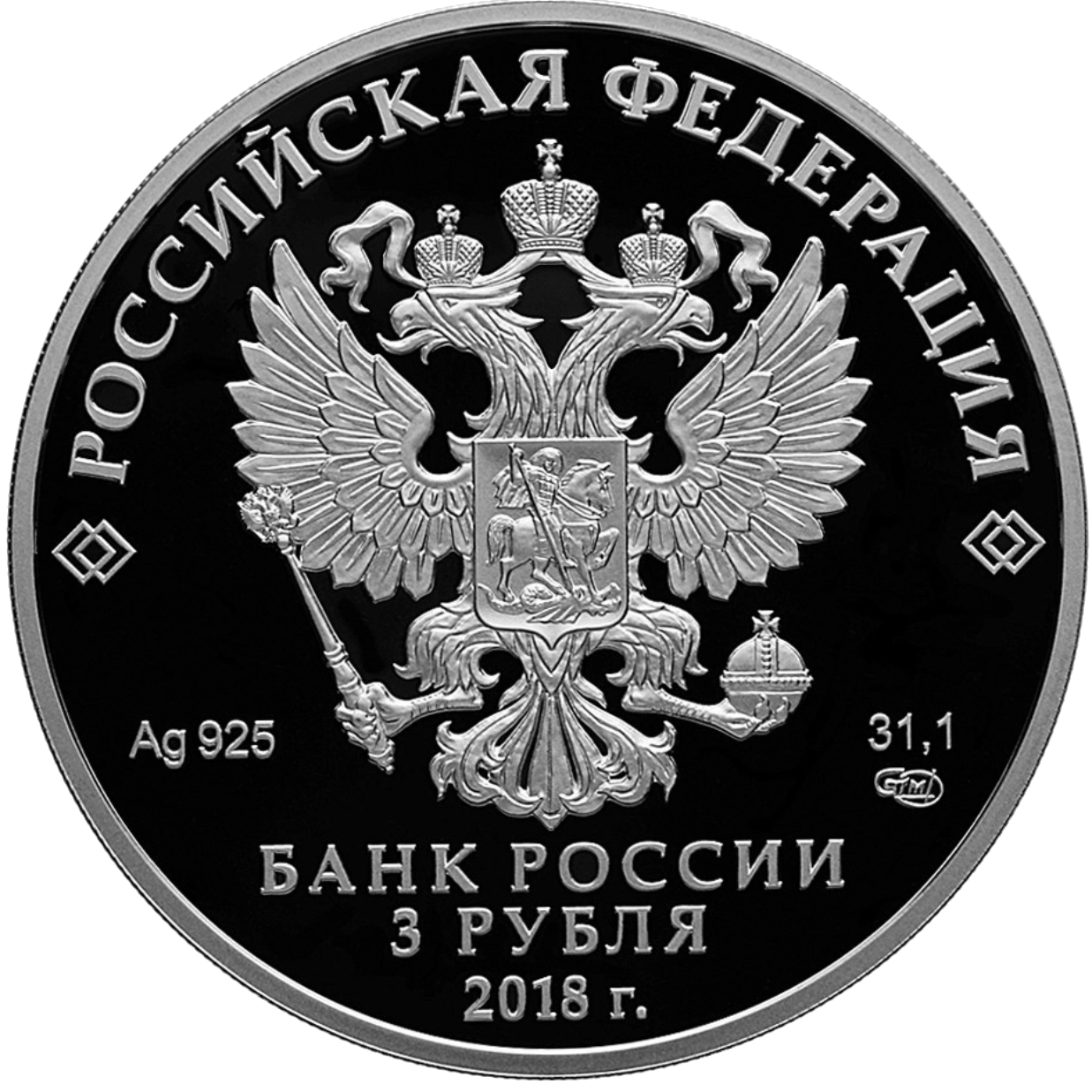
The obverse is occupied by the state coat of arms of Russia in relief, a double-headed eagle beneath crowns, placed on the mirror field of the disc. At the top, along the very edge of the disc, the name of the state, RUSSIAN FEDERATION, is placed, with rhombuses at the sides. Beneath the arms the institution that issued the coin is named, BANK OF RUSSIA, in three lines; the denomination, the year and the mint mark are given there as well. The obverse was designed by the artist E. V. Kramskaya and sculpted by A. A. Dolgopolova.
Reverse
The reverse presents a cartouche with the monument to Peter the Great and the name of the city, SANKT-PETERBURG, set in two lines. The background is made of folk patterns and football motifs. A bright coloured arc, the trace of a flying ball, divides the cartouche from the player. The inscription CHEMPIONAT MIRA PO FUTBOLU FIFA 2018 V ROSSII (FIFA World Cup 2018 in Russia) runs around the circumference. A. A. Brynza drew the reverse, and the relief was made by computer modelling.