
The Golden Cup
PDFGeneral information

Description
The main prize of the football world is the FIFA World Cup Trophy. The one presented today was designed by the Italian sculptor Silvio Gazzaniga. In the early 1970s FIFA announced a competition for a new trophy for the tenth World Cup, to be held in 1974: the earlier Jules Rimet Cup stayed with Brazil for good after its third victory in 1970. Fifty-three designs came in from experts of seven countries, and Gazzaniga's design won. He described his work as lines that rise from the base in spirals and stretch out to receive the world, while from the tense body of the sculpture emerge the figures of two athletes at the moment of victory.
Two human figures holding the globe on raised arms are the main image of the trophy. The cup is made of gold and decorated at its base with two bands of malachite; on its underside are engraved the names of the winners and the years of the championships. The rules of FIFA are arranged so that the original stays with the federation: after the awards ceremony the champion receives a gilded copy, while the real trophy returns to storage. For that reason no team can say that it owns the cup for ever, and in every four-year cycle it waits for a new master.
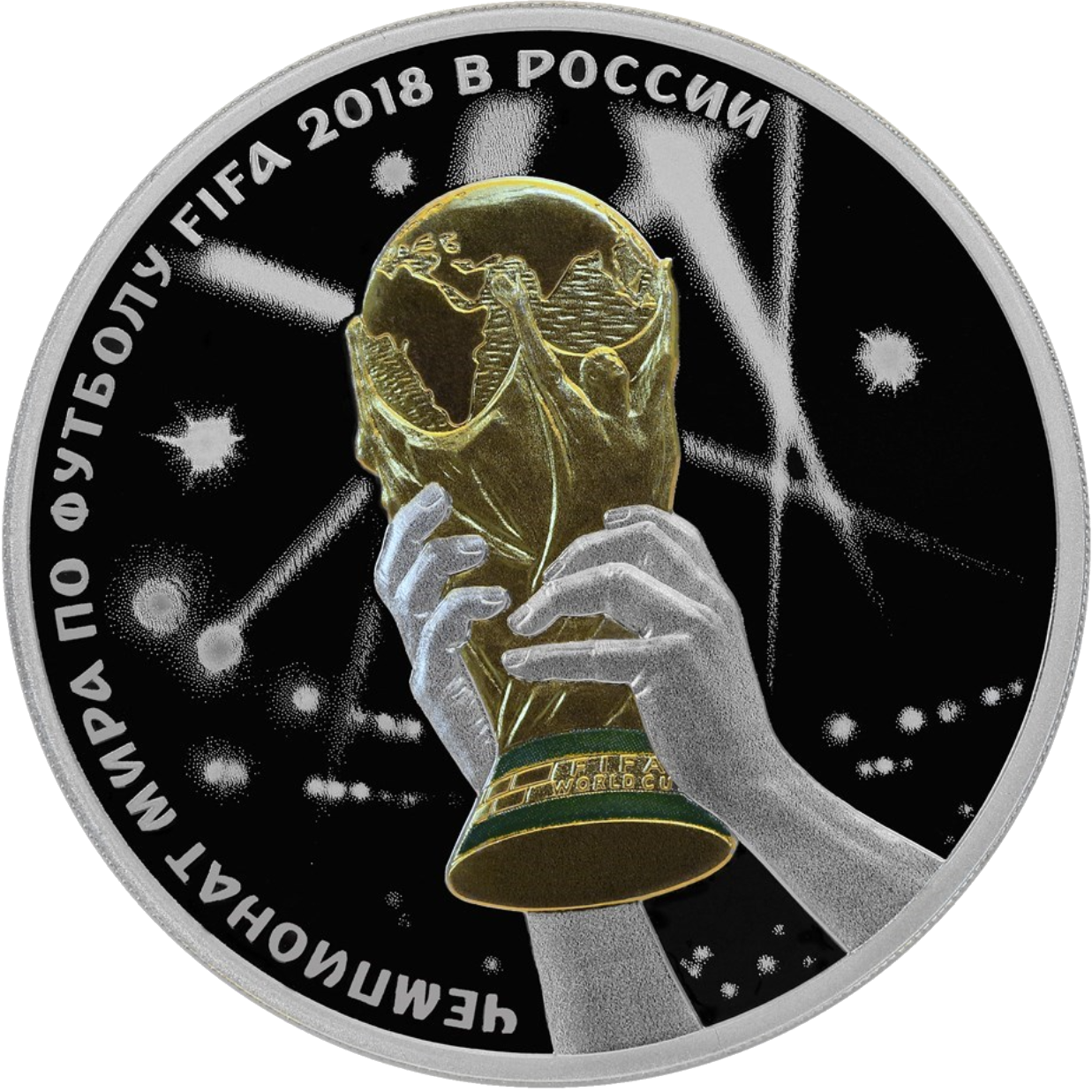
On the coin the Cup is shown against a stylised bowl of a stadium, a reminder that the champion's decisive match is played in an arena where tens of thousands of spectators gather. In 2018 that arena was Luzhniki. On 15 July France, beating Croatia 4:2, lifted the Cup for the second time in its history; before that the French had won in 1998 on home soil. For collectors the name Golden refers to the most precious colour of the trophy and to the dream of every team to win it.
The 2018 championship was the first to be held in Russia, and the Cup was in the country not only as an exhibit. It made a great journey through the cities before the tournament and then met its challengers at the final. The image of the Cup is placed at the centre of the composition of the coin to stress that for spectators, players and the whole country it is the main symbol of world football.
The first World Cup was held in 1930 in Uruguay: thirteen teams gathered in Montevideo, and in the final at the Centenario stadium Uruguay beat Argentina 4:2. The idea of the tournament was put forward by the FIFA president Jules Rimet, and it was he who gave his name to the first trophy. The 2018 championship was the twenty-first, and with every edition the history of the Cup was enriched with new names.
Obverse
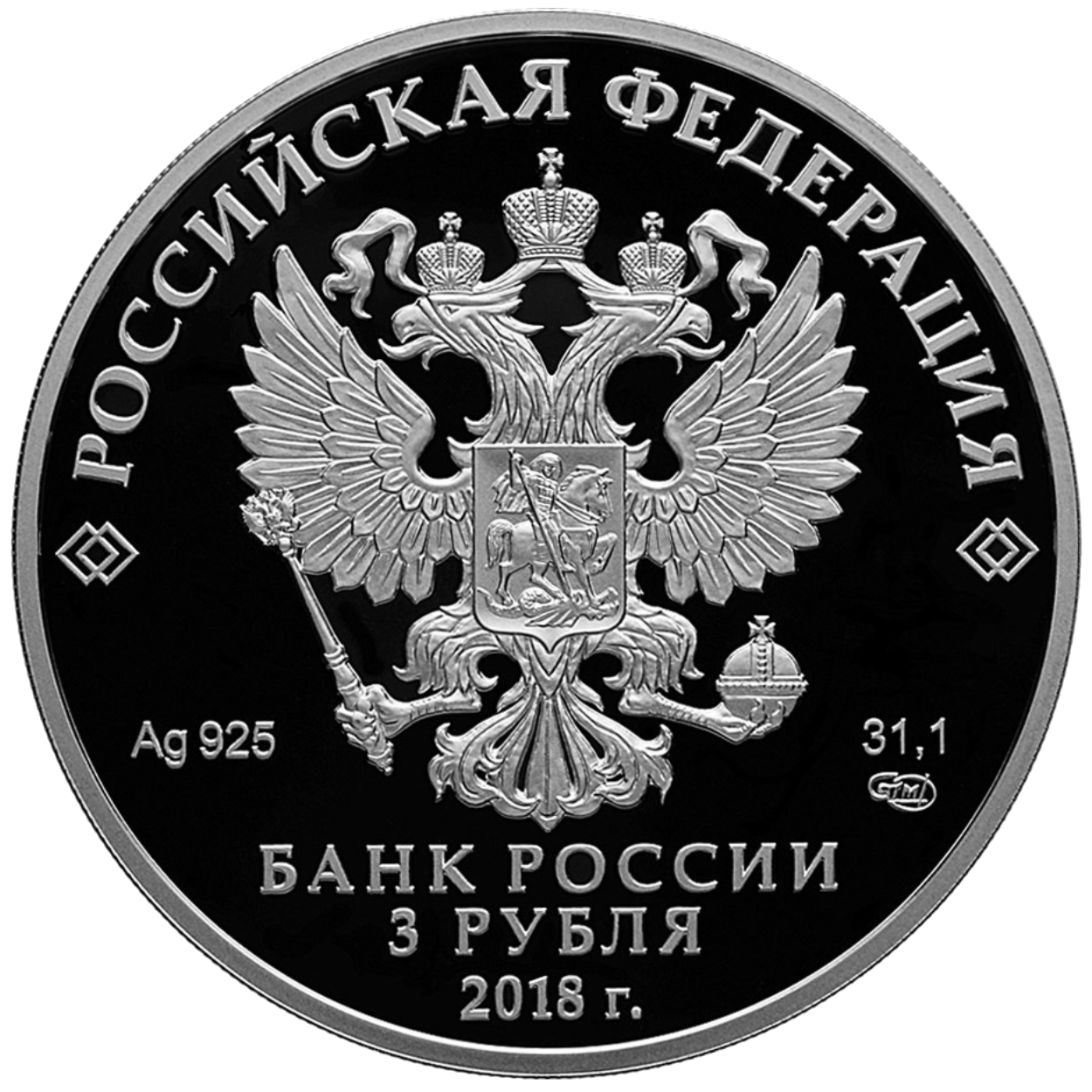
The main element of the obverse is the relief state emblem of the country, placed on the mirror field of the disc: an eagle with raised wings beneath three crowns. Along the upper edge, in a semicircle, stretches the inscription RUSSIAN FEDERATION, with two rhombuses on either side of it. In the lower part, in three lines, is struck BANK OF RUSSIA, with the denomination and the year of issue shown, and beside the arms the trademark of the mint is visible. The obverse was designed by the artist E. V. Kramskaya and sculpted by A. A. Dolgopolova.
Reverse
The reverse shows the relief image of the FIFA World Cup Trophy against a stylised stadium bowl; around the circumference runs the inscription CHEMPIONAT MIRA PO FUTBOLU FIFA 2018 V ROSSII (FIFA World Cup 2018 in Russia). S. A. Kozlov drew the reverse and A. N. Bessonov modelled it.