
Nizhniy Novgorod
PDFGeneral information
Description
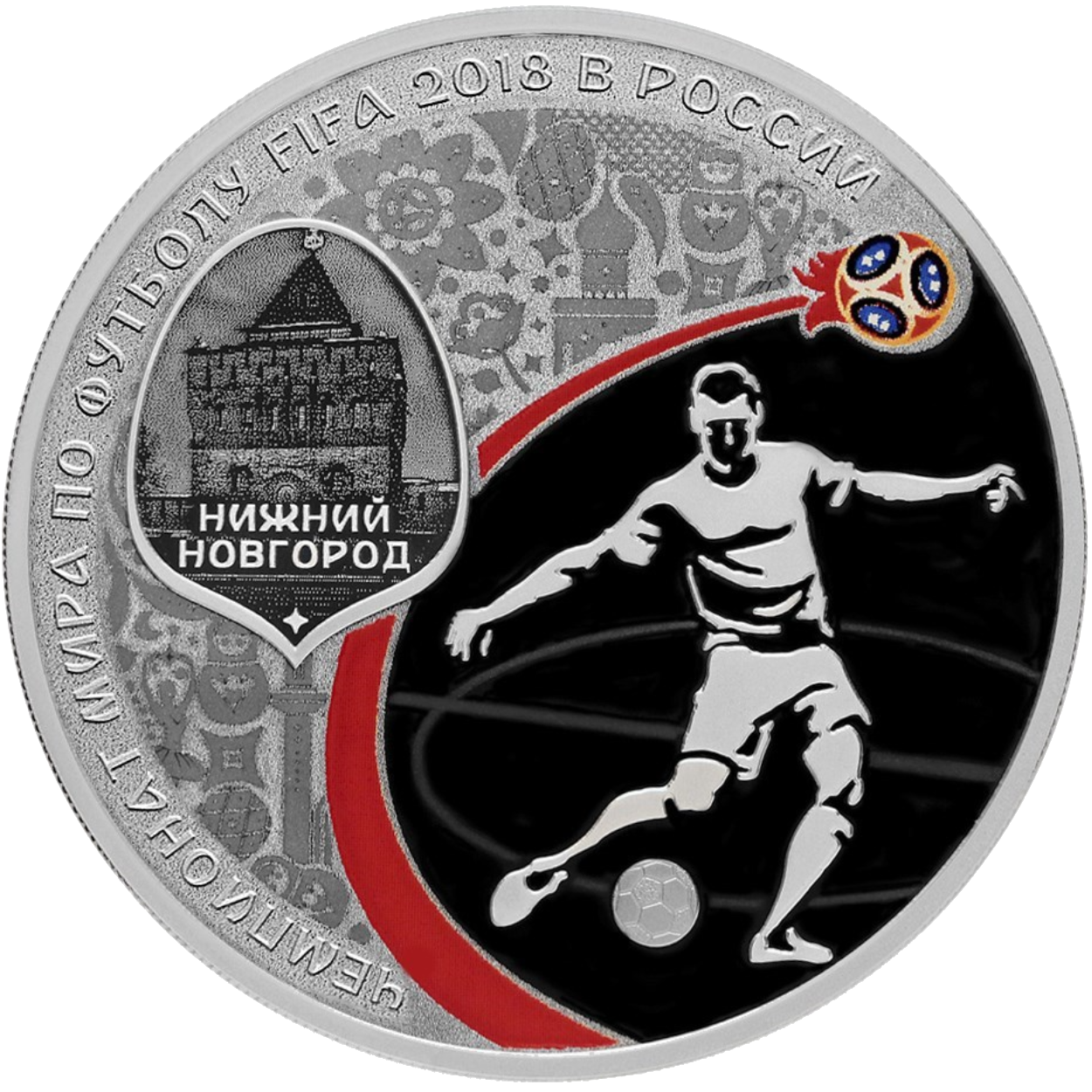
On this coin Nizhny Novgorod is shown by its kremlin, a red-brick fortress on the high bank of the Volga. It was built from 1500 to 1515 under Ivan III and Vasily III, and tradition links its design with the Italian master Pietro Francesco. The walls and towers circle the hill above the confluence where the Oka flows into the Volga; the Dmitrovskaya Tower serves as the main gate. It is said that in its long history the kremlin was never taken by storm; today it houses government offices and museums.
The city was founded in 1221 by Prince Yuri Vsevolodovich of Vladimir at the meeting of two rivers. In 1611–1612 the Nizhny Novgorod elder Kuzma Minin called on the townspeople to raise a militia, and together with Prince Dmitry Pozharsky it freed Moscow from the Polish troops. Later Nizhny became famous for the Makaryev and then the Nizhny Novgorod Fair, regarded as the main trading event of the empire, and in the Soviet period the city bore the name of Maxim Gorky (1932–1990).
The Nizhny Novgorod Stadium stands on the spit where the Oka meets the Volga. Sweden beat South Korea 1:0 here, Croatia crushed Argentina 3:0, England defeated Panama 6:1, and in the quarter-finals France overcame Uruguay 2:0. The kremlin on the reverse of the coin ties the football championship to the centuries-old history of a city that has always stood on the road between Moscow and the Volga.
Among the heroes of the tournament was Harry Kane: the English striker scored six goals and won the Golden Boot, and three of them came in the match against Panama, which was played in Nizhny Novgorod. The best player of the championship was named as the Croat Luka Modrić, the best young player as the Frenchman Kylian Mbappé, and the best goalkeeper as the Belgian Thibaut Courtois. Croatia reached the final for the first time in its history. Nizhny Novgorod, which has been called the third capital, proved a hospitable city: fans walked along Bolshaya Pokrovskaya Street, and pleasure boats worked on the river.
The kremlin on the coin is surrounded by an ornament in which traditional patterns of Russian painted decoration can be recognised. This too is tied to the city: nearby, in Gorodets and Khokhloma, famous masters work whose patterns have long entered world culture.
For the people of Nizhny Novgorod themselves the kremlin remains the place to which guests are brought first, and the view from its walls over the meeting of two great rivers is the best way to understand why the city was founded precisely here. The coin returns the viewer to this view.
Obverse
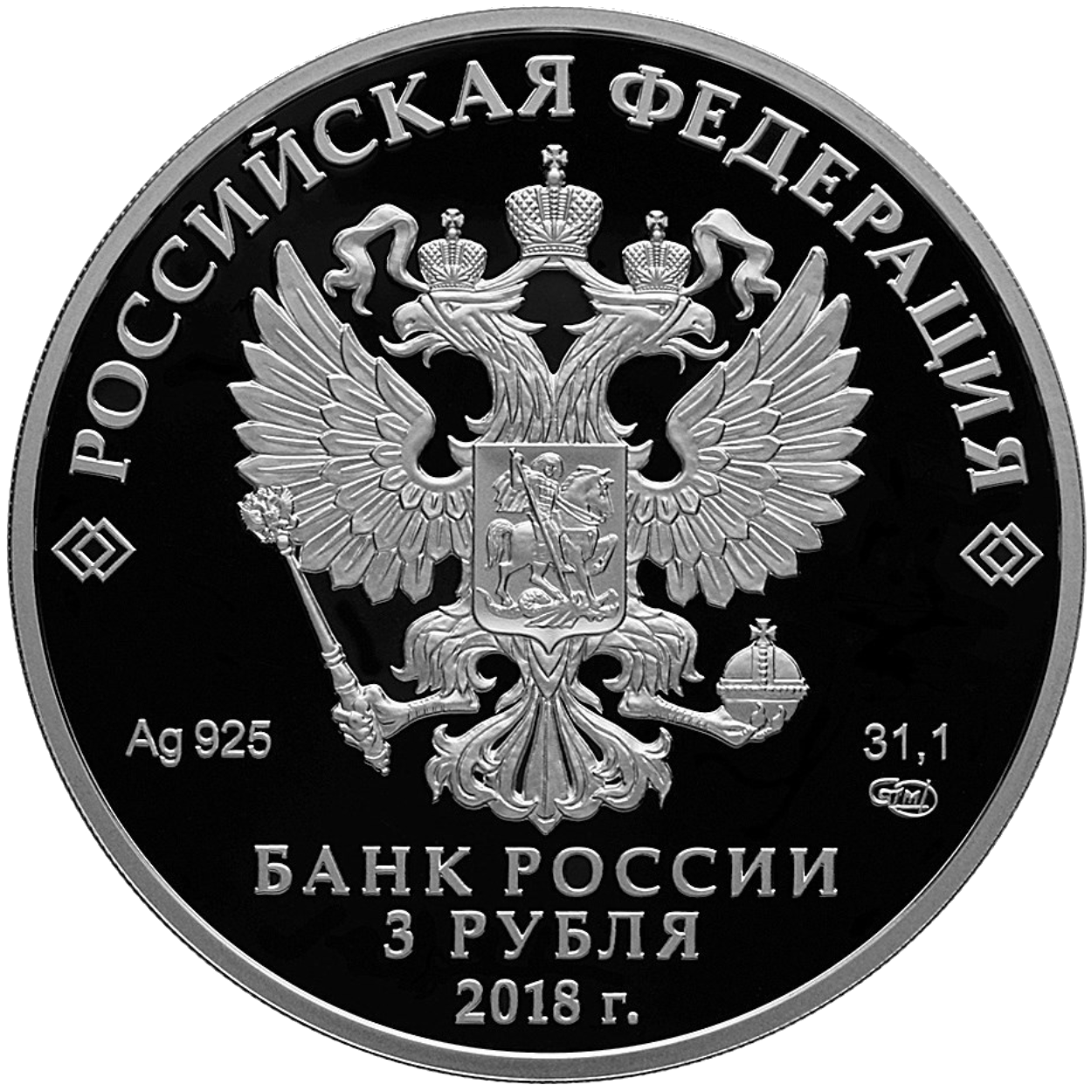
The obverse is occupied by the state coat of arms of Russia in relief, a double-headed eagle beneath crowns, placed on the mirror field of the disc. Above the emblem, along the rim, runs the inscription RUSSIAN FEDERATION (РОССИЙСКАЯ ФЕДЕРАЦИЯ), framed on both sides by paired rhombuses. Lower down, in three lines, is written BANK OF RUSSIA; next to this inscription the year and the denomination are shown, and the mint mark sits to the side of the emblem. E. V. Kramskaya drew the obverse and A. A. Dolgopolova modelled it.
Reverse
On the back of the coin there are a cartouche with the Nizhny Novgorod Kremlin and the name NIZHNY NOVGOROD in two lines. The ornament around them joins folklore and football. A coloured flight path of the ball separates the cartouche from the figure of a footballer. The name of the tournament is struck around the circle: CHEMPIONAT MIRA PO FUTBOLU FIFA 2018 V ROSSII. The reverse design was created by A. A. Brynza; computer modelling took the place of a sculptor here.