
Smolensk
PDFGeneral information

Description
Smolensk is called the key to Moscow: both Napoleon's army and the German troops of 1941 passed through it. The Battle of Smolensk lasted from 10 July to 10 September 1941. Army Group Centre counted on crossing the Dnieper and the Western Dvina quickly and reaching the Moscow axis, but the Soviet forces, though encircled, did not let it be done quickly: the German advance was held up for almost two months. For the Red Army this was the time needed to prepare the defence of Moscow.
Near Smolensk several events took place that became symbols of the war. In mid-July 1941 near Orsha and Rudnya multiple rocket launchers were used in battle for the first time, which the soldiers later called "Katyushas". The battery of Captain Ivan Flyorov brought a fiery storm down on concentrations of equipment, and the Germans were shocked. And in September Soviet troops at Yelnya, in the Smolensk area, carried out the first successful operation to eliminate a German salient. The four rifle divisions that distinguished themselves in these battles were the first to receive the title of Guards.
Smolensk itself fell on 16 July 1941, and the occupation lasted more than two years. The liberation of the city in September 1943 was the result of the Smolensk offensive operation, which ran from August to October and became one of the largest operations of summer and autumn 1943. On 25 September 1943 the city was liberated, and on Smolensk soil traces of those battles can be seen even today.
Smolensk received the title of Hero City in 1985, for the fortieth anniversary of the Victory, for the mass heroism and courage of its defenders in the struggle for the freedom and independence of the Motherland.
Smolensk land is for ever linked in memory with the events of 1812 and 1941. In 1812 Smolensk was defended by the forces of Barclay de Tolly and Bagration, and the battle under its walls in August was the first serious engagement of the Patriotic War. A hundred and thirty years later an enemy was again coming by the same road. Here, near the village of Yartsevo, heavy fighting took place in early July 1941, and in Smolensk the defenders held out to the last: despite being half-surrounded, units of the 16th and 20th Armies went on fighting, and a considerable part of them later made their way back to their own lines. The occupation also brought grief: the city suffered cruelly, its historic centre was destroyed, and its inhabitants were driven away or killed. Tragic pages are also tied to Smolensk land, such as Katyn, where Polish officers were shot in 1940. Today the city, with its ancient fortress wall that has survived many wars, preserves the memory of its defenders and liberators.
Obverse
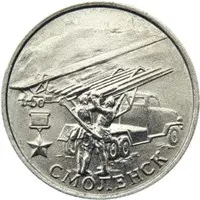
The artistic side: in the centre two gunners load a "Katyusha", on the left a launcher fires a salvo, below is the Gold Star medal, and in the background the outline of the city. Along the bottom is SMOLENSK.
Reverse
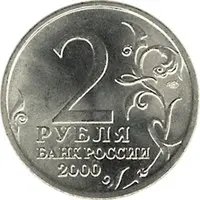
The official side: the mark of value, the inscription BANK OF RUSSIA, the year 2000 and stylised branches at the sides.