
Murmansk
PDFGeneral information

Description
Murmansk is the largest city north of the Arctic Circle, founded in 1916 as a port that does not freeze, thanks to a warm current. It was this feature that determined its fate in the war. From the autumn of 1941 Allied convoys came here with Lend-Lease cargoes: tanks, aircraft, lorries, food, medicines. Part of the cargo went to Arkhangelsk, but the key role was played by the port of Murmansk. The convoys sailed through the North Atlantic and the Barents Sea under threat from German submarines, aircraft and surface ships.
The city itself found itself dangerously close to the front. In September 1941 a German mountain corps from Norway tried to break through to Murmansk, but was stopped on the Western Litsa river, some fifty kilometres from the city. This front line held until the autumn of 1944. The Luftwaffe bombed Murmansk ceaselessly: in 1942 most of the wooden buildings burned down, but the port went on working and receiving ships.
Ships of the Northern Fleet and aviation that covered the convoys were also based here. Submarines of the Northern Fleet sank German vessels off the coast of Norway. Merchant seamen and naval sailors of different countries who sailed to Murmansk and back formed a special community: among them were many British, Americans and Russians.
The title of Hero City was conferred on Murmansk in 1985, for the fortieth anniversary of the Victory, for the courage of the defenders and inhabitants of the polar city.
For the Allies the northern convoys were a matter of risk and sacrifice. Most of the ships sailed from Iceland or from Scottish ports, and every voyage might end in tragedy: German submarines and aircraft sank vessels, and Arctic storms and ice added to the difficulties. One of the hardest cases was convoy PQ-17 in July 1942, when only eleven of thirty-five transports arrived. Merchant seamen, Soviet ones among them, struggled to deliver the cargo, and warships of the Northern Fleet and aviation guarded the approaches. In Murmansk itself the port and ship-repair workshops worked, crates with American and English markings lay on the quays, and Allied military missions lived in the city. Today on the shore above the Kola Bay stands the memorial "To the Defenders of the Soviet Polar Region", known to locals as Alyosha.
Obverse
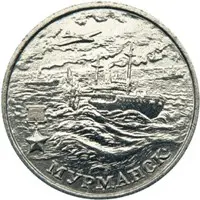
The artistic side shows two transport ships of a sea convoy, beside them a column of water from an explosion and above them an aircraft; on the left is the Gold Star medal, on the right a warship. Along the bottom runs the inscription MURMANSK.
Reverse
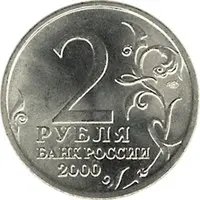
The official side: the mark of value, the inscription BANK OF RUSSIA, the year 2000 and stylised branches to left and right.