
Novorossiysk
PDFGeneral information

Description
Novorossiysk lies on the shore of Tsemes Bay, and in 1942 German and Romanian troops seized most of the city. In September 1942 fighting went on in the streets, but the port and the eastern part remained in the defenders' hands. The front then froze for months, and it was in this situation in February 1943 that sailors carried out a daring operation, the landing on Malaya Zemlya.
On the night of 4 February 1943 a marine detachment under Major Tsezar Kunikov, about 275 men, landed at the suburban settlement of Stanichka. The main landing that was to strike from the sea went astray, and Kunikov's detachment was left alone. It dug in on a narrow beachhead which came to be called Malaya Zemlya, "the Small Land". Kunikov was mortally wounded on 14 February, but the beachhead was held and expanded, and over the months it became the base for preparing the decisive blow.
Malaya Zemlya held out for 225 days, until September 1943. The assault on Novorossiysk began on 10 September from the sea and from the land; marines landed directly into the port, and ships of the Black Sea Fleet took part in the fighting for the city. On 16 September Novorossiysk was liberated. The battles for the city were especially fierce: the front beside Tsemes Bay was felt by everyone who fought there.
The title of Hero City was conferred on Novorossiysk in 1973 for the mass heroism and courage of its defenders in the struggle for the freedom and independence of the Motherland in the Great Patriotic War. The memorial complex on Malaya Zemlya is today one of the most visited memorial sites in the south of Russia.
Malaya Zemlya became not only a military but also a memorial place. Beside Tsemes Bay lies the Sugar Loaf hill, at whose foot the fighting for the liberation of the city went on, and on Cape Myskhako the main forces of the landing came ashore. Leonid Brezhnev served among the fighters of Malaya Zemlya, then a political officer of the 18th Army, and decades later his memoirs of it, published as a separate book, were known across the country. For the men who fought there the beachhead remained above all a place of hard daily work: trenches were dug in the soil, ammunition was carried under fire, and at night reinforcements were brought across the sea and the wounded taken out. After the liberation of the city a memorial ensemble was created on the spot, and by the sea a monument was set up to the marines of the landing, among them Tsezar Kunikov, who was posthumously made a Hero of the Soviet Union.
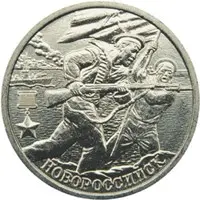
Obverse
The artistic side shows two marines at the moment of attack, one with a rifle, the other holding a banner, with the Gold Star medal on the left and in the background a warship and the outline of the city. Along the bottom runs the inscription NOVOROSSIYSK.
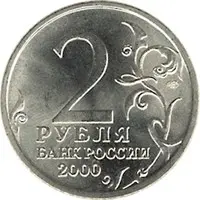
Reverse
The official side: the mark of value, the inscription BANK OF RUSSIA beneath it, the year 2000 and stylised branches at the sides.