
Stalingrad
PDFGeneral information

Description
The Battle of Stalingrad ran from July 1942 to February 1943 and became the turning point of the war. In the summer of 1942 German troops were driving toward the Volga and the Caucasus. On 23 August the city suffered a terrible bombing: the air force turned it into ruins, but the defenders held the wreckage and the fighting moved into the streets. The army of Vasily Chuikov, holding a narrow strip along the Volga, kept the factories, Mamayev Kurgan and the famous House of Pavlov: a group of soldiers led by Sergeant Yakov Pavlov defended an apartment block in the centre of the city for weeks.
In September Alexander Rodimtsev's 13th Guards Rifle Division crossed the Volga under fire and went into battle at once at the railway station and on Mamayev Kurgan. Fighting went on for every floor, cellar and workshop. The soldiers called it the "war of the rats". Order No. 227, known as "Not a step back", required holding on at any price, but as veterans recalled, what held the men was not the threat but the knowledge that beyond the Volga there was no land for them.
On 19 November 1942 the counter-offensive Operation Uranus began. Soviet armies closed a ring around Paulus's Sixth Army from the flanks, and the attempt to relieve it failed. On 31 January 1943 the southern group of the encircled forces surrendered, and on 2 February the remnants of the northern group laid down their arms. With their commander some ninety thousand men went into captivity. It was the first catastrophe of such scale for the Wehrmacht, and the initiative on the front finally passed to the Red Army.
The title of Hero City was conferred on Stalingrad in 1965 together with the Order of Lenin and the Gold Star medal; the city had been named among the first in the order of the Supreme Commander of 1 May 1945.
The significance of the Battle of Stalingrad is spoken of in both figures and symbols. The fighting covered a huge area, from the factories of Stalingrad, the Tractor Plant, Barricades and Red October, to the steppe between the Volga and the Don. Factory shops passed from hand to hand, and shooting went on between the machine tools. The sniper Vasily Zaitsev, operating in the ruins, became known to the whole army, and the example of his fellow snipers inspired dozens of pupils. Over the city rises Mamayev Kurgan, Height 102, for which particularly many fighters died; today it holds a memorial with the monument "The Motherland Calls!". The victory at Stalingrad also had international significance: Germany's allies in the Hitler bloc began to doubt success, and resistance grew stronger in the countries occupied by Germany. The city itself was rebuilt after the war, and in 1961 it was renamed Volgograd.
Obverse
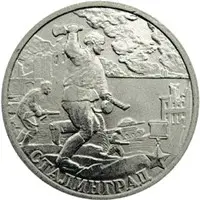
The artistic side shows soldiers at the moment of attack, with the Gold Star medal on the right, a ruined house and, in the background, the outline of a burning city on a riverbank. Along the bottom runs the inscription STALINGRAD.
Reverse
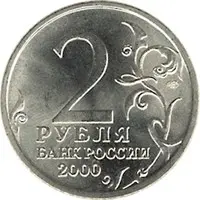
The official side carries the mark of value in two lines, the inscription BANK OF RUSSIA, the year 2000 and stylised branches to left and right.