
Year of the Sheep (Gold 1 kg)
PDFGeneral information

Description
Chinese time is counted not only in years but in pairs of signs: a Heavenly Stem joins an Earthly Branch, and a sixty-year cycle results. In 2027 the pair that falls due in this cycle is 丁未 — Dingwei. The stem 丁 belongs to yin fire, and the branch 未 belongs to the sheep (or goat — the character 羊 allows both readings). The calendar year begins on 6 February with the new moon and the Spring Festival and ends on 25 January 2028. The same pair was last named in 1967.
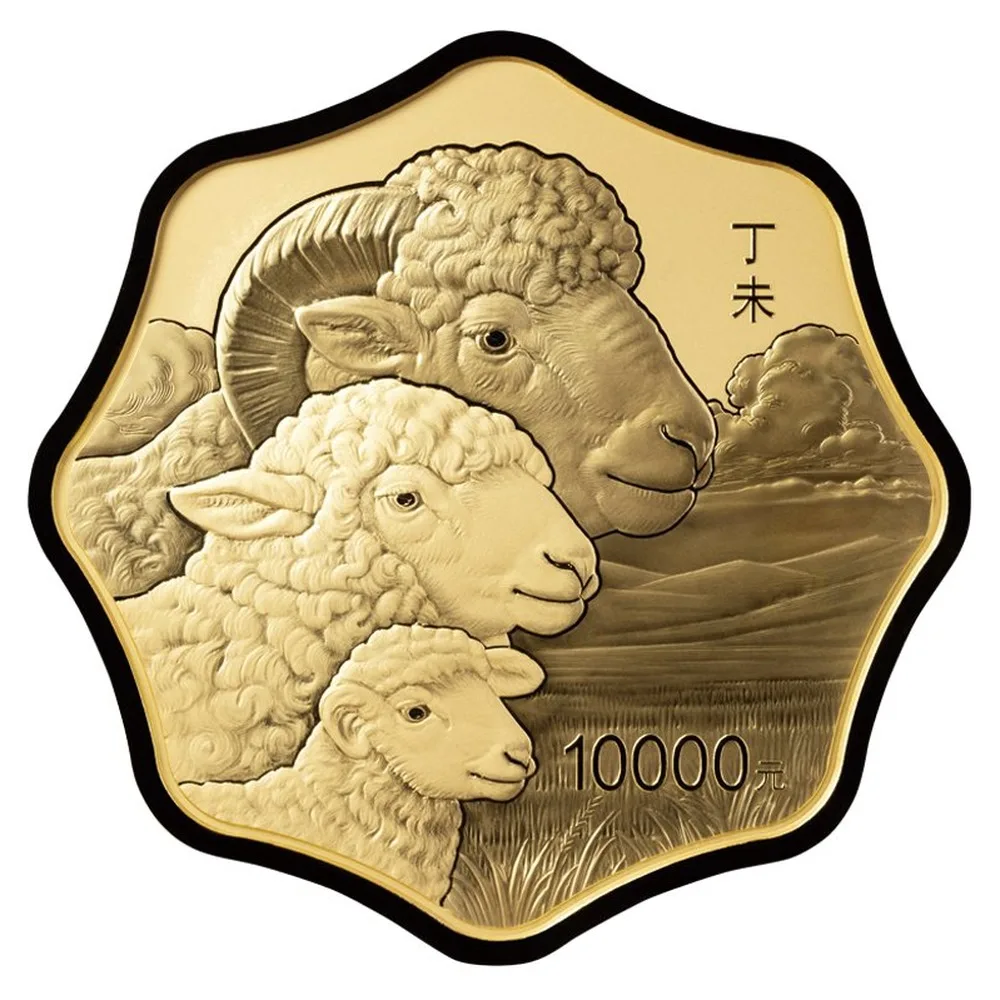
This year's coin gives the main role to a single sheep — and gives it the whole landscape too. The sheep is shown against mountains, meadows and clouds. There is no crowd and no bustle: the animal stands on its own meadow, slopes rise behind it, and clouds drift above them. Every line here is subordinated to calm. This is not a parade portrait but rather a genre scene: here is a pasture, here are mountains, here is the sky — and in the centre a living creature that feels at home.
Mountains and clouds are a very Chinese pair. In traditional painting mountains give a picture its vertical, while clouds that fill the foothills and passes turn the dense stone mass into a light, breathing image. Every summit seems to float above the mist. In ornament the cloud is also a sign of luck: it is no accident that "auspicious clouds" (祥云) became one of the most widespread patterns. A sheep against such a sky turns out to be both a pastoral heroine and a messenger of good news.
What is usually attributed to the sheep sign? In Chinese astrological tradition, goats and sheep are peace-loving, kind and liked by those around them. This quality is well reflected in the "character" of our subject: before us is not a fighting ram with threatening horns but a quiet, unhurried inhabitant of the meadow. It is busy with the simplest thing — living, grazing, looking at the mountains. For a culture in which the chief New Year wish remains peace in the home and harmony, such an image is the best start to a year.
The word 羊 is woven into the brightest Chinese concepts. It is part of the character 祥, "auspicious", and of the character 善, meaning kindness and virtue; in the ancient language 羊 and 祥 were interchangeable. So the sheep on the coin is not just an animal but a sign of a good omen that can be seen in the very writing of the word. Reading such an image, a Chinese viewer sees not a small creature but the wish for a year that will "set out on a good road".
What are the mountains and meadows for? They turn the subject into a picture of the world. The meadow is plenty and shelter, the mountains are protection and permanence, the clouds are the movement of time and the change of seasons, from winter to spring. The Spring Festival marks exactly this turn: by tradition it celebrates the arrival of warmth, and homes are cleaned to sweep out last year's misfortunes and make room for happiness. A sheep among the clouds fits that mood well — it seems to have come out into the open to meet the new spring.
This coin has one quality that is hard to put into words: it works through silence. The large, smooth outline of the animal, the soft lines of the clouds, the even line of the horizon — together they create a sense that time has stopped for a moment. For a zodiac subject this is a rare but fitting trait: the year of the Fire Sheep arrives with red lanterns and fireworks, while the coin, on the contrary, offers a minute of quiet amid the festive noise — and perhaps that minute holds its most sincere New Year thought.
Obverse
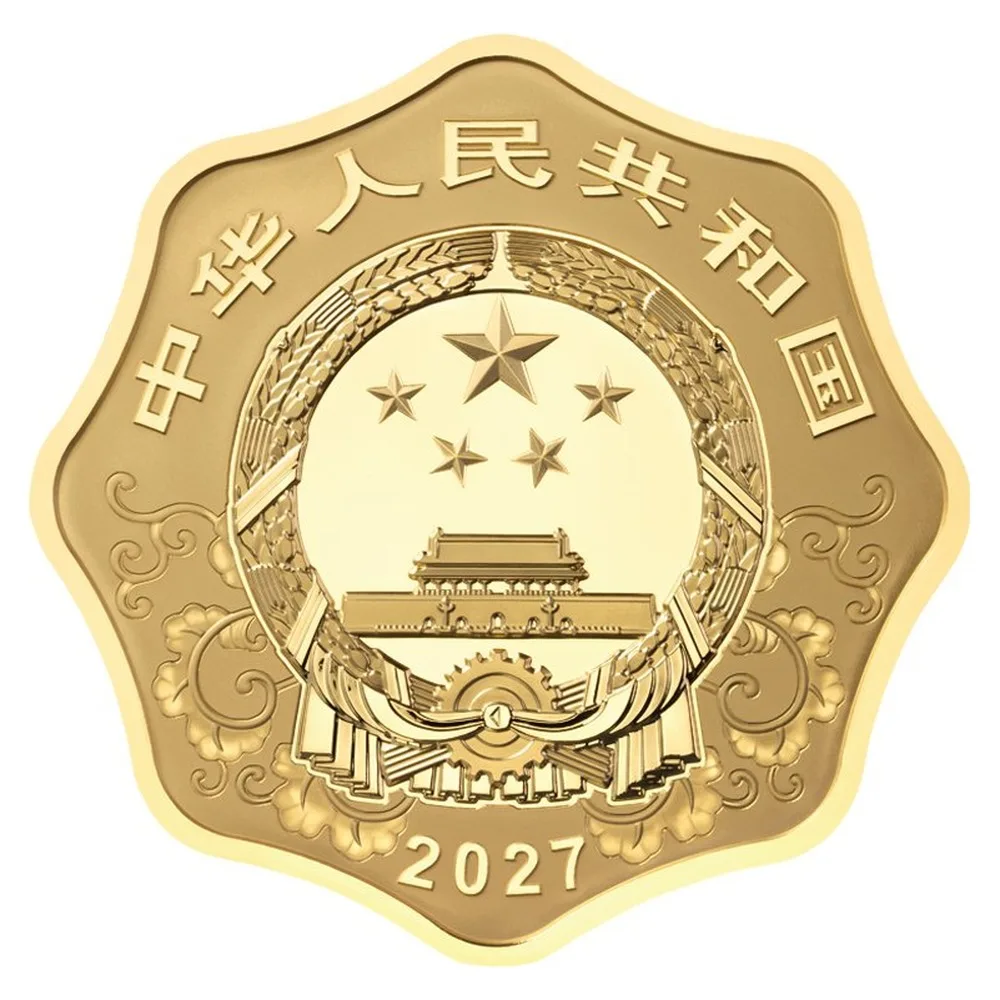
The obverse bears the national emblem of the People's Republic of China. It is surrounded by traditional auspicious patterns, which form a handsome frame around the central emblem. The composition is completed by inscriptions: the name of the country, 中华人民共和国, and the year, 2027. Strict symmetry, the rhythm of the ornamental curls and the crisp characters give this side a solemn, official character. It calmly balances the landscape subject on the reverse, where everything is built on soft lines and open space.
Reverse
The reverse shows a sheep against mountains, meadows and clouds. The animal is placed at the centre of the scene, and a landscape unfolds around it: meadows, distant mountains, and clouds above them. The mountains and sky recede into the distance, while the sheep, by contrast, steps forward. The inscription 丁未, marking the year, stands here as well. Overall the composition conveys the image of a peaceful pasture, a corner where nothing disturbs the calm. The clouds soften the border between earth and sky, and the even light makes the scene quiet and spacious.