
Year of the Sheep (Gold 3 g)
PDFGeneral information


Description
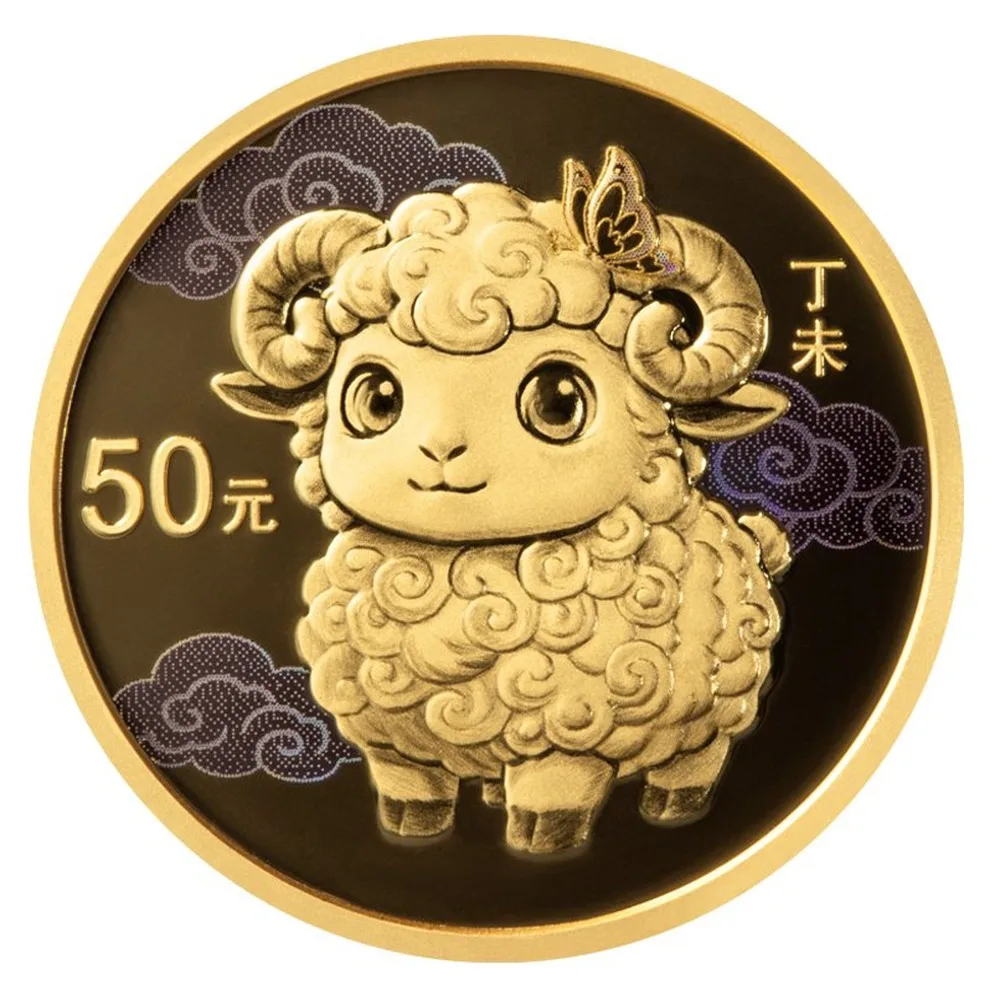
The lightest and brightest scene of the year Dingwei is on this coin. There are no mountain ranges here, no heraldic horns, no solemn patterns: before us is a cartoon lamb among auspicious clouds and butterflies. Its little face is good-natured, its eyes are large, and a butterfly sits on the lamb's head, the way it settles on a flower. Everything in this picture seems drawn for a child and for the sake of a child.
Children hold a special place in the Chinese New Year. On the morning of the first day they are wished health and growing strength, and in return they receive red envelopes — yasuiqian. An old legend explains the origin of this custom: on New Year's Eve a demon named Sui would pat a sleeping child on the head three times, making the little one fall ill with fever. Then parents began to wrap coins in red paper and put them by the pillow; when the demon approached, the gleam of the coins drove him away. So a gift turned into protection. A lamb in clouds and butterflies is a sort of visible wish for such a child: may the year be bright and safe.
The clouds on the coin are not a backdrop but a full participant in the subject. Auspicious clouds (祥云) are a common Chinese wish-pattern: a cloud that carries good omens. A lamb surrounded by such clouds seems to float across the sky itself, as in a children's tale. The word 祥, "auspicious", is already contained in the writing of the character 羊: in it the sheep is the bearer of good news, so the clouds and the sheep add up to one meaning twice over.
The butterfly adds mobility to the subject. It is a creature of spring: it appears when winter leaves and the earth warms. And the Spring Festival with which the year begins — 6 February 2027 — is precisely about this turn. While it is still cool outdoors, spring images are already blooming on cards and windows. A butterfly that has landed on the lamb's head seems to announce: spring has come, one may leave the house.
The choice of the cartoon manner is understandable. For zodiac coins it has long been a way to speak to a new audience — to those just getting acquainted with Chinese culture and with collecting. Instead of complicated symbolism there is a simple and pleasant story that can be told to a child: a lamb walks on the clouds, a butterfly has sat on its head, and no one is afraid. It is no accident that a review calls it a convenient entry point for beginners.
In Chinese tradition the sheep is considered a gentle, peace-loving, friendly animal, and this character shows here without extra words. The fiery element of the year Dingwei, which might sound loud, is softened on this coin into a warm light; the only "red" motif is the mood of the festival.
One can say that this coin is a children's New Year card made as a keepsake. It does not try to explain the calendar and does not go deep into mythology, yet in mood it hits the very heart of the Spring Festival: joy, lightness, hope for a good year and the warm feeling that one's own people are near.
Obverse
The obverse of the coin is occupied by the national emblem of the People's Republic of China, surrounded by auspicious patterns. Along the edge are read the name of the country, 中华人民共和国, and the year, 2027. The patterns form a neat, handsome frame, while the emblem remains in the centre as the main sign. The restrained design of the obverse sets off the playful picture on the reverse and underlines the festive character of the whole piece.
Reverse
The reverse shows a cartoon lamb surrounded by auspicious clouds and butterflies. Light curls of cloud unwind around the little figure, and a butterfly sits on the lamb's head. The drawing is kept in a light, childlike manner: soft outlines, big eyes, a good-natured expression. The inscription 丁未, giving the year, is present. The subject conveys the mood of a joyful spring festival.