
Year of the Sheep (Gold 10 kg)
PDFGeneral information

Description
On Saturday, 6 February 2027, the Spring Festival arrives by the Chinese calendar, and with it the year 丁未 — Dingwei — begins. It runs until 25 January 2028. The sign of the year is 未 (wèi), the eighth of the twelve Earthly Branches, and its animal is called 羊 (yáng) in Chinese: one word covers both the sheep and the goat. The Heavenly Stem 丁 brings the element of Fire, which is why this is called the year of the Fire Sheep. This combination last came around in 1967, and the next one will take a full sixty-year cycle.
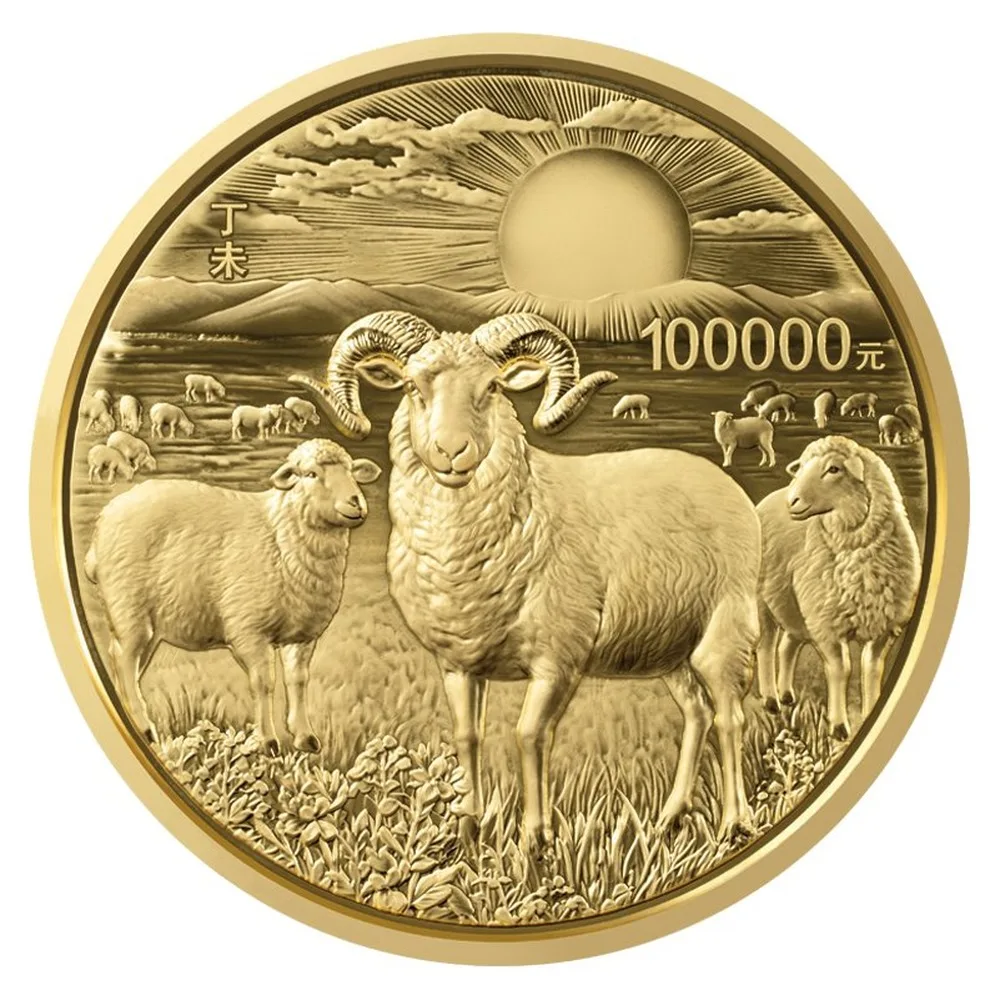
There is no lonely animal on an empty field on this coin. A whole panorama is unfolded here: a flock of sheep, and behind it the sun, mountains and water, and spreading meadows. In the foreground three sheep stand on the grass, and a large herd can be seen in the distance. It is a view from above, like a landscape scroll: the eye first catches the nearby animals, then travels to the mountains and water, and returns to the sun. The story is not about one sheep but about the well-being of a whole community — a pasture where there is enough grass for everyone.
In the old Chinese reckoning of the day, each sign has its own two-hour span. The hour of the sheep falls between 13:00 and 14:59 — in the ancients' view, the time when goats eat grass. The coin seems to have stopped exactly that moment: noon has passed, the sun is high, the animals graze and are in no hurry. A calm, unhurried rhythm is the main note of the whole composition.
Particular meaning in this picture belongs to the three sheep under the sun. They echo one of the best-loved New Year wishes — 三阳开泰, "three yang open up prosperity". The phrase comes from the Book of Changes. There the twelve months are matched with hexagrams: the tenth month is pure yin, the hexagram kun; in the eleventh a single bright yang line is born from below, in the twelfth two, and by the first month of the year there are already three — this is the hexagram tai, "peace and harmony". Winter withdraws, warmth grows, and everything turns toward the good. Later, on folk pictures and patterns, the wish came to be drawn literally: three sheep and the sun. The words 羊 and 阳 sound the same in Chinese — yáng — and this pun made sheep ideal messengers of spring. In Journey to the West the heroes even devise three rams to "answer" this saying and dispel misfortune.
So a panorama of a flock beneath the sun reads as a wish put into pictures. Mountains and water give steadiness and abundance, the meadow gives plenty, the sun is that very yang which gathers strength with every day, and three sheep recall the start of the year. There is no person on the coin, but one can be sensed: it is through his care that these sheep graze, and for him such a picture is a sign of a good year.
This subject also has a quiet link with the festival itself. Chinese New Year is the time when families gather for a shared reunion dinner and then give children red envelopes. A flock in a meadow is the same image of unity: many different animals, but one home, one pasture, one order. The sheep is considered an auspicious animal in Chinese culture: the character 羊 is part of the word 祥 ("auspicious, fortunate") and of 善 ("good, kindness"). So the scene of a peaceful herd is both the expectation of a prosperous year and a dream of a kind life, in which everyone has a place on the common meadow.
The person holding the coin can study this picture slowly, as one studies a Chinese landscape: from the blades of grass in the foreground to the distant ridges. The longer one looks, the more details open up — and the clearer it becomes that the main thing here is not a single animal but a feeling of open space, peace and shared well-being.
Obverse
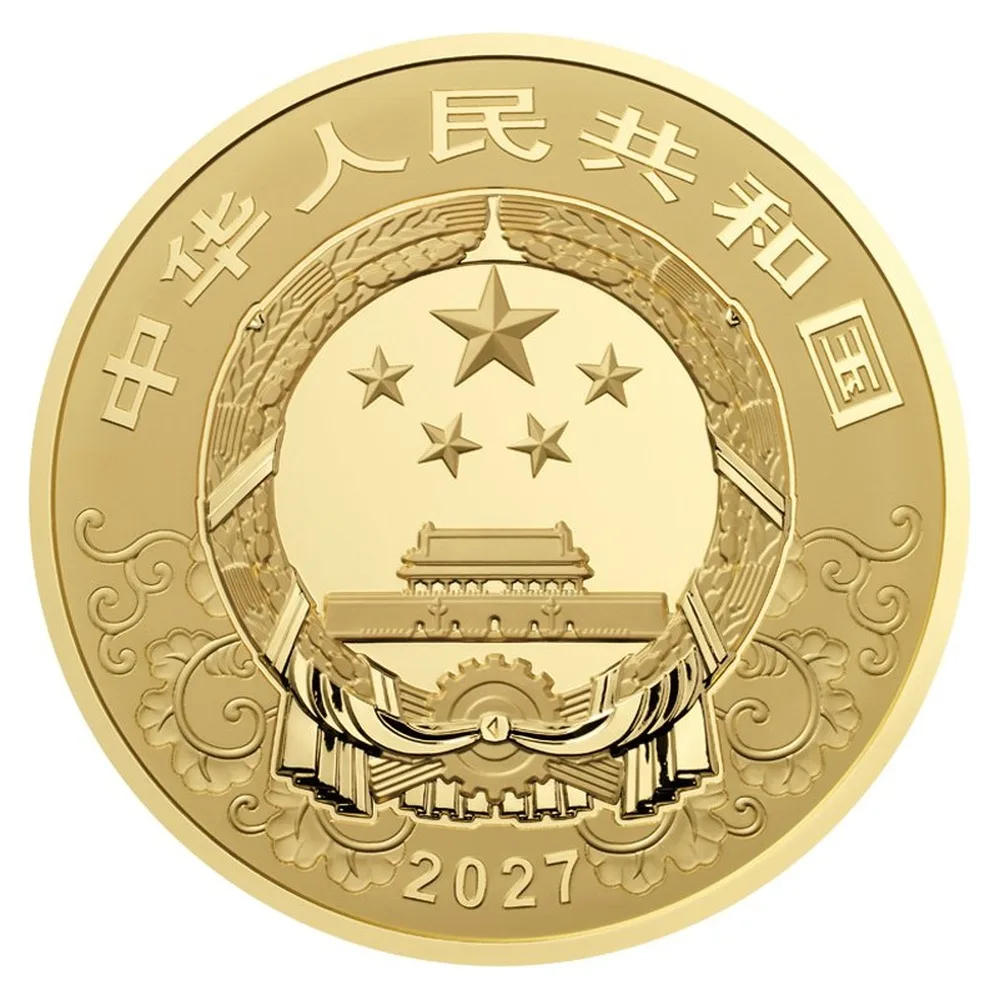
The obverse carries the national emblem of the People's Republic of China. It is surrounded by a traditional ornament of auspicious patterns — the kind that have long been placed in China on objects meant to convey wishes of good luck. These curls give the official side a festive, almost New Year look. The inscriptions are placed here as well: the name of the country, 中华人民共和国, and the year, 2027. Everything is arranged strictly and symmetrically, so that the calm, solemn obverse sets off the lively, many-figured scene on the reverse.
Reverse
The reverse is a panorama of a pasture. A flock of sheep is set against the sun, mountains and water: three sheep stand on the meadow, while a herd moves in the distance. The perspective recedes into depth, and the landscape reads like a scroll with a meadow. Among the details is the traditional inscription 丁未, marking the year of the Fire Sheep. The composition is built so that the eye slides from the grass in the foreground to the far slopes and rises to the sun, and the overall mood is peaceful, plentiful and harmonious.