
Year of the Sheep (Silver 1 kg)
PDFGeneral information

Description
The year Ding-wei (丁未) begins on 6 February 2027 and runs until 25 January 2028. In the Chinese calendar it is the year of the Fire Sheep: the heavenly stem "ding" carries yin fire, while the earthly branch "wei" belongs to the sheep, or goat. The previous Ding-wei fell in 1967, so the sixty-year circle has closed exactly once since then. The coin in question does not tell a story in the usual sense: there is no shepherd, no meadow and no flock on it. Its subject is the good news the sheep itself brings, and the language in which that news is written: ornament.
The key to the image lies in a single character. The sign 羊 (yang) is a component of the word 祥 (xiang), "auspicious" or "fortunate". According to the English-language article on the sign, the two were interchangeable in ancient Chinese. The same 羊 sits inside the character 善 (shan), whose meanings include kindness and benevolence. It follows that a sheep in Chinese art is never just a picture of an animal: it is a graphic wish, written with the very sign that is used to write the word for good fortune.
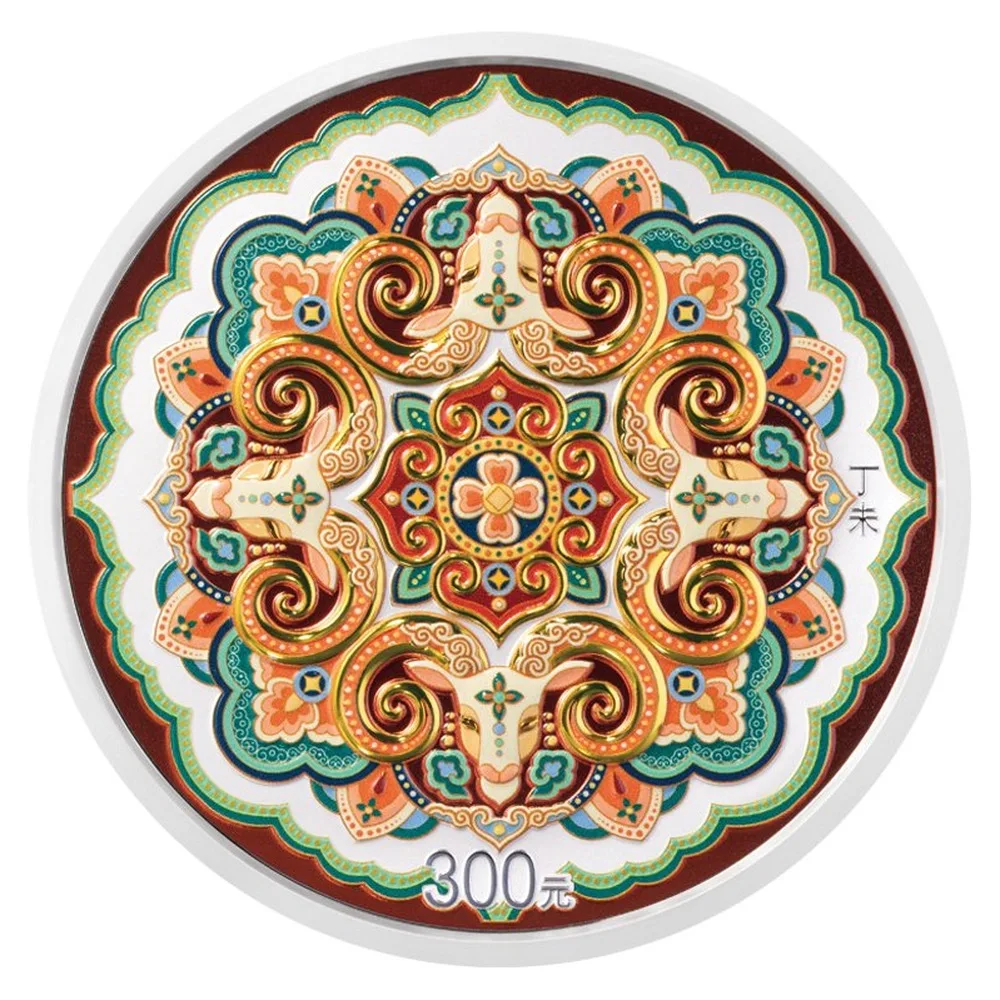
That is why the coin shows the sheep not as a creature of the pasture but as a decorative figure. Its form is built like a pattern: the lines are calm, the silhouette is gathered and balanced, and nothing in it hurries or alarms. Around it spread auspicious patterns, the kind that for centuries have adorned textiles, carved wood, porcelain and paper cuttings for the New Year. Every such curl reads as a small wish, and together they add up to one long sentence about peace in the home.
The review of the collectors' issue that we rely on describes this work simply: "羊" sounds like "祥", so the image carries a wish for accord and harmony. Accord here means more than the absence of quarrels. It is the peaceable nature of the sheep itself, good relations within a family, and a fitting balance between people and the season. It is no accident that Chinese astrology describes the Goat as peace-loving, kind and likeable.
The Chinese New Year, or Spring Festival, is exactly the time when such wishes are spoken loudest. The house is cleaned to make room for happiness, the family gathers at one table, children receive red envelopes, and paired inscriptions with kind words appear on doors and windows. A decorative sheep with auspicious patterns is closest in spirit to those New Year inscriptions: it, too, hangs on the "door" of the year and says the same thing to everyone who enters: may there be harmony.
There is one more old thread. In the legend of the contest of the animals before the Jade Emperor, the sheep received eighth place, neither the first prize nor the last. It was rewarded neither for speed nor for ferocity. For a sign that stands not for victory but for balance, a decorative, almost jeweller's manner of depiction suits better than any other: it speaks not of strength but of concord.
So the coin becomes a small New Year card written in an old language: a sheep, ornaments, a wish. Whoever knows that 羊 and 祥 share a common root will read more in it than the eye sees, and whoever does not will still sense the calm, warm tone of the image, made to be set in a prominent place at the start of the year.
Obverse
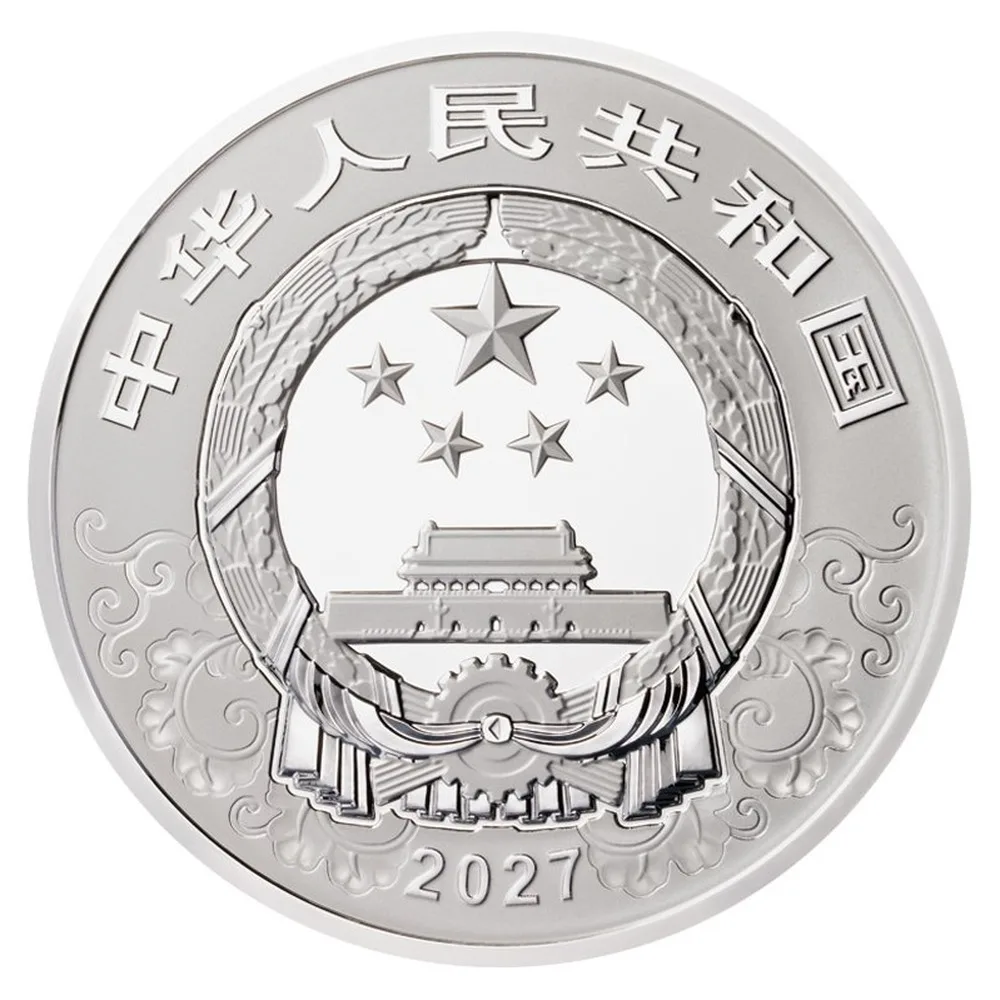
The official side carries the national emblem of the People's Republic of China. It is encircled by a ring of traditional auspicious patterns, the kind that people in China give for luck and weave into festive decoration. Along the edge run the name of the country, 中华人民共和国 (Zhonghua Renmin Gongheguo), and the year, 2027. The composition is stately: the central emblem sets an official tone, while the ornament softens it and ties the obverse in spirit to the reverse, where the theme of auspicious signs continues.
Reverse
The pictorial side is devoted to a decorative sheep. The figure is stylised, deliberately calm, and surrounded by auspicious patterns that pick up its outline and flow across the field. The inscription 丁未 (Ding-wei), the name of the year, stands here as well. The central idea of the image is the echo between 羊 and 祥: the sheep as the bearer of a wish for accord, harmony and family well-being. Everything rests on soft lines and ornamental rhythm, without narrative detail.