
Year of the Sheep (Gold 150 g)
PDFGeneral information

Description
In the Chinese zodiac the sheep stands in eighth place — between the horse and the monkey. Several legends explain how this order came about. According to one, the Jade Emperor told a servant to bring the twelve most beautiful animals for a reward. The rat came first, having ridden cleverly on the ox's back and played a little pipe; the ox was given second place for kindness, the tiger third, the rabbit fourth for its fur, the dragon fifth for its unusual appearance, the snake sixth for wisdom. The horse was assigned seventh place, the sheep eighth, the monkey ninth for its agility. So the eighth place was fixed for the sheep for ever — and with it the branch 未.
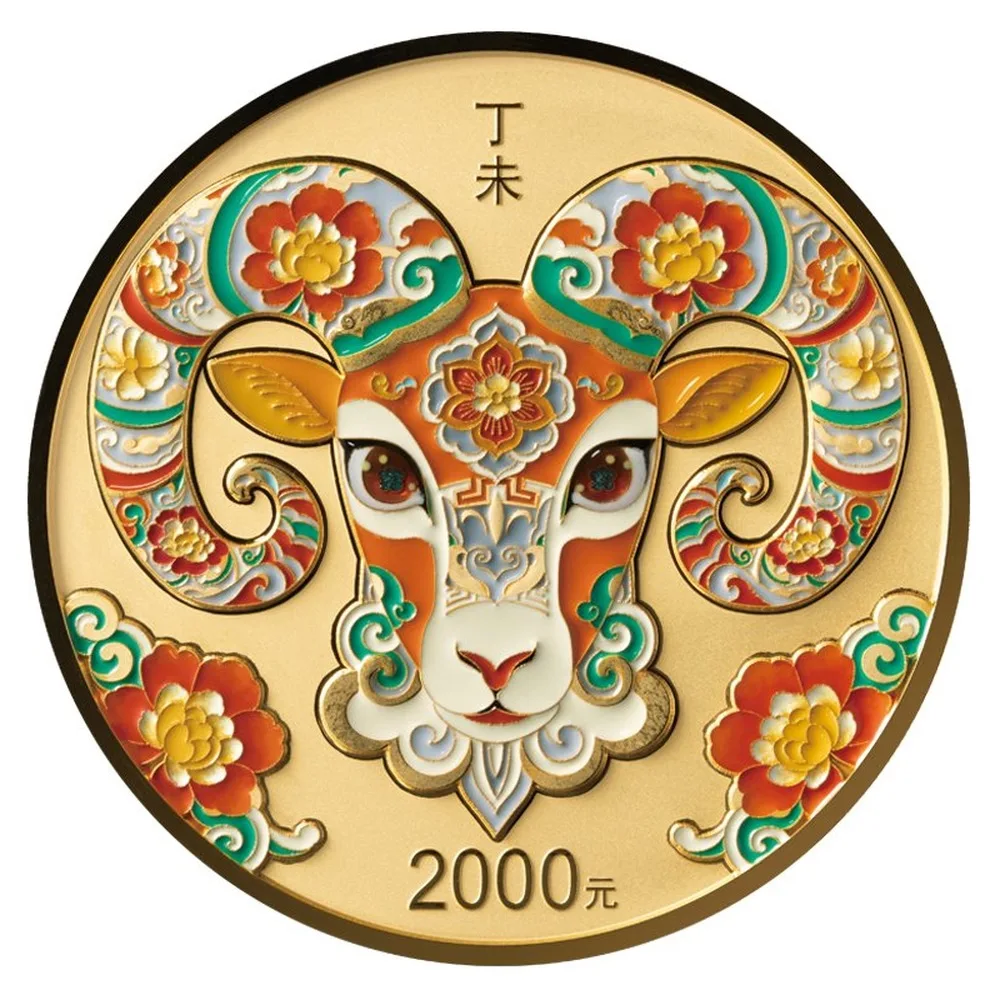
This year's coin turns not to the flock and not to the whole body of the animal but to a single head. It is a decorative ram's head with mighty horns, set in a symmetrical frame of auspicious flowers. Such a composition is built on an axis: the left and right sides mirror each other, the horns curl toward each other, and the flowers spread their petals to both sides. The eye comes to rest at the centre — on the animal's face — and then slides smoothly along the curves of the horns to the floral border.
The ram is a strong image. Horns on a ram are a natural mark of might and dignity. Here the same assonance comes to mind: 羊 and 阳 are pronounced identically in Chinese. A ram's head with spread horns framed by flowers becomes a sort of coat of arms — solemn, as found on ceremonial objects and seals.
The flowers around the head soften this stern image. Auspicious flowers (吉祥花卉) in the Chinese tradition express a wish for wealth and well-being, and in the coin's composition they play the part of an honorary garland. A strong, horned animal finds itself in a tender frame, and there is meaning in this contrast: true strength in the Chinese view does not contradict kindness. After all, the character 羊 is part of both 善, "kindness", and 祥, "auspicious". A sheep can be mighty — and good-natured at the same time.
It is curious how the role of the sheep-ram has changed over the calendar cycles. The year 丁未 is the forty-fourth in the sixty-year cycle by the modern table of correspondences; it came to replace 1967. On this coin the sheep is presented as a head alone, as a sign, as a seal. This "portrait" version recalls heraldry: before us is the emblem of the year.
The festival with which this year begins is the Spring Festival, 6 February 2027. On its eve families gather for the reunion dinner and exchange greetings and wishes of good health. A ram's head in flowers is a fitting adornment for such a table: smart, festive and at the same time weighty. It speaks neither of pasture nor of road, but of honour and plenty, which people wish one another in the first days of the year.
The collector's interest in such a subject lies in its clarity. There are no narrative details to decipher: horns, face, flowers — that is all. But it is exactly this brevity, symmetry and solemnity that make the image memorable. One feels in it what the Chinese call jixiang — auspiciousness, which pervades every line.
Obverse
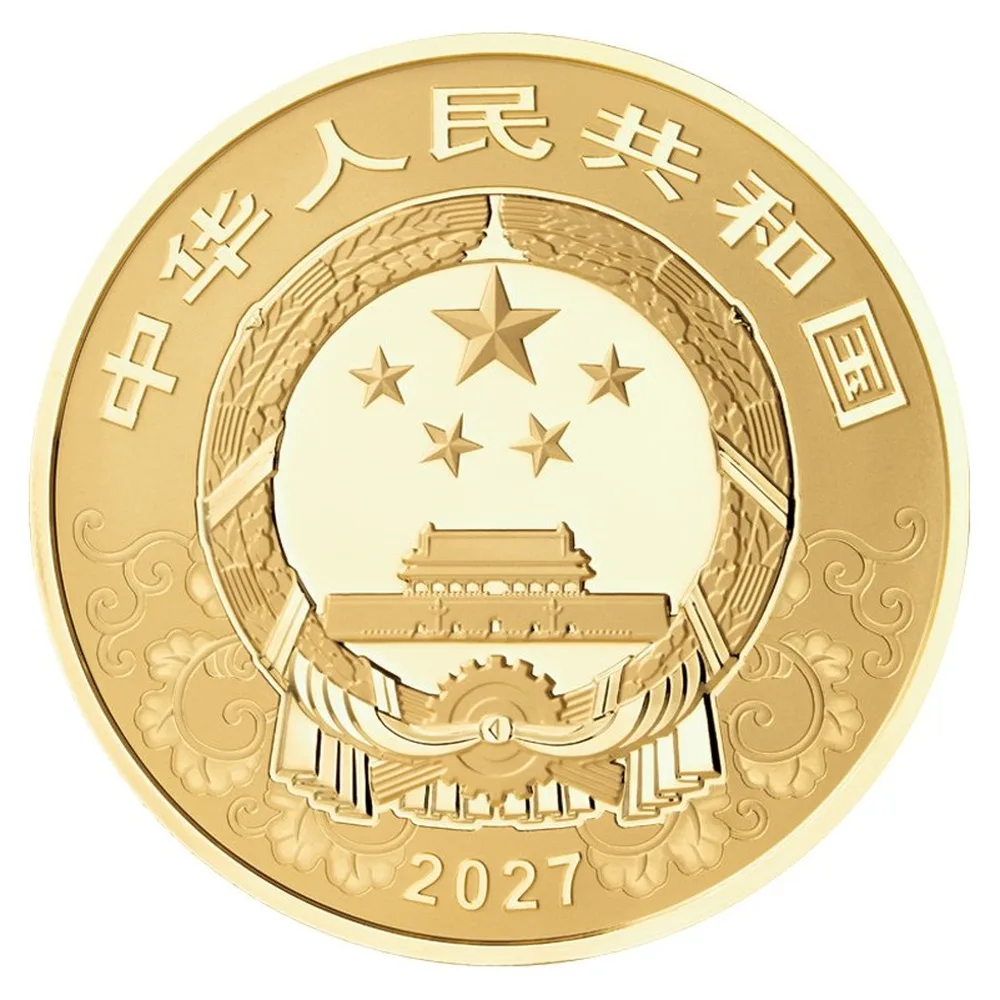
The obverse carries the national emblem of the People's Republic of China, surrounded by auspicious patterns. Above and below it traditional curls are arranged, forming a symmetrical frame. Around them are the inscriptions — the name of the country, 中华人民共和国, and the year, 2027 — with clear, solemn lettering. The strict axial symmetry of the obverse echoes the mirror composition of the reverse, where the ram's head is likewise placed at the centre.
Reverse
The reverse is a decorative ram's head with large curling horns. It is surrounded by a symmetrical frame of auspicious flowers: the petals spread from the centre to both sides, repeating the bends of the horns. The composition is built on a vertical axis, so it looks solemn and balanced. The inscription 丁未, giving the year, is present. The image expresses a wish for wealth and well-being, embodied as an almost heraldic emblem.