
Year of the Sheep (Silver 150 g)
PDFGeneral information

Description
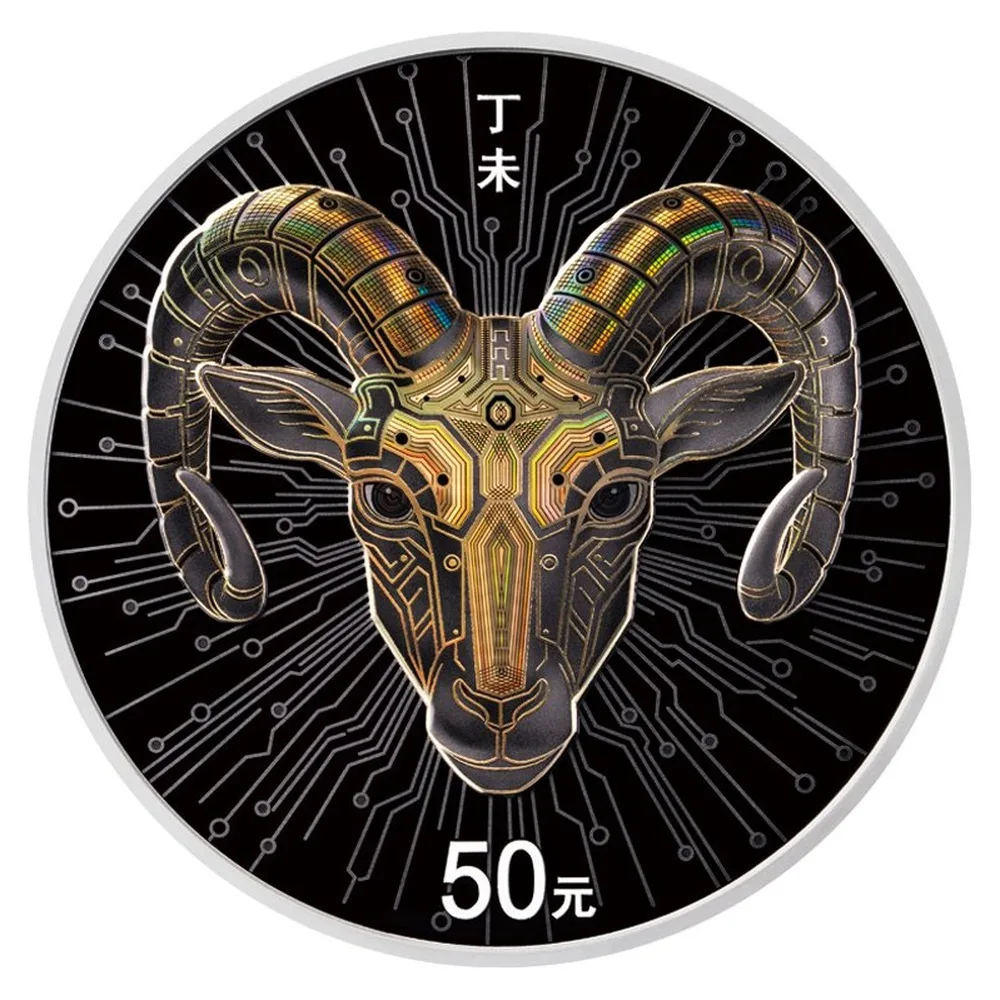
This coin has the most unexpected hero in the whole zodiac cycle: a ram's head assembled not from wool and flesh but from the parts of a mechanism. Across it run the tracks of a printed circuit board, with the nodes and jumpers of a microchip. An animal that China is used to seeing as meek and domestic seems here to be plugged into a network. The review of the collectors' issue calls this work the most contrasting of the lot: it steps outside the familiar zodiac image and brings an ancient subject and modern design into one composition, with a metallic, almost armoured texture, as in the mechs of science fiction.
To grasp how bold this solution is, it helps to recall where the twelve animals came from at all. According to the Russian-language Wikipedia, since the Han dynasty the earthly branches had been used to count the hours of the day, and later, for convenience, they were replaced by animals. The day was divided into twelve two-hour watches, and each was given its own animal. The sheep received the hours from one to three in the afternoon, when goats, in the popular imagination, graze on grass. So from the very beginning the zodiac was a way of putting time in order, something like an ancient clock. The mechanical ram on the coin brings back that core meaning: time, the cycle, a repeating motion.
The year Ding-wei begins on 6 February 2027 and ends on 25 January 2028. It is called the year of the Fire Sheep, and the element is especially apt here. Fire is the hearth, the forge flame, and the current in a wire. The heavenly stem "ding" corresponds in the calendar to yin fire, that is, a quiet, even fire, like a votive lamp. An image in which the sheep meets an electrical circuit reads as a playful but precise continuation of that element: the quiet fire of the ancient calendar and the quiet current of modern technology.
It should be noted that the subject does not deny tradition. The ram remains a ram: the head, the horns, the strict symmetrical silhouette, all that by which it is recognised on any zodiac coin. What changes is the "matter" of the image. Instead of woolly curls there is a pattern of contacts, and instead of bead-like eyes a mechanical gaze. This is not a contrast but a conversation: the old sign receives a new voice and uses it to say the same thing.
And what it says is that for the Chinese a year always arrives like a familiar guest. The previous Ding-wei fell in 1967, and since then the world has changed so much that the blueprint of today's microchip would have looked like fantasy then. But the Spring Festival stays the same: the family at the table, red envelopes, good wishes. The cycle of twelve animals has survived the Han, technological upheavals and changes of eras precisely because it knows how to take on new forms.
So the coin becomes a visible answer to a question young collectors often ask about the zodiac: has it become outdated? The mechanical ram with its microchip pattern answers without words: no, it is simply switched on. For those used to seeing only a pastoral landscape in the sheep, such a work will be a pleasant surprise, and for those who love the meeting of cultures and eras it is almost a manifesto of the year: tradition does not stand still, it plugs into the future.
Obverse
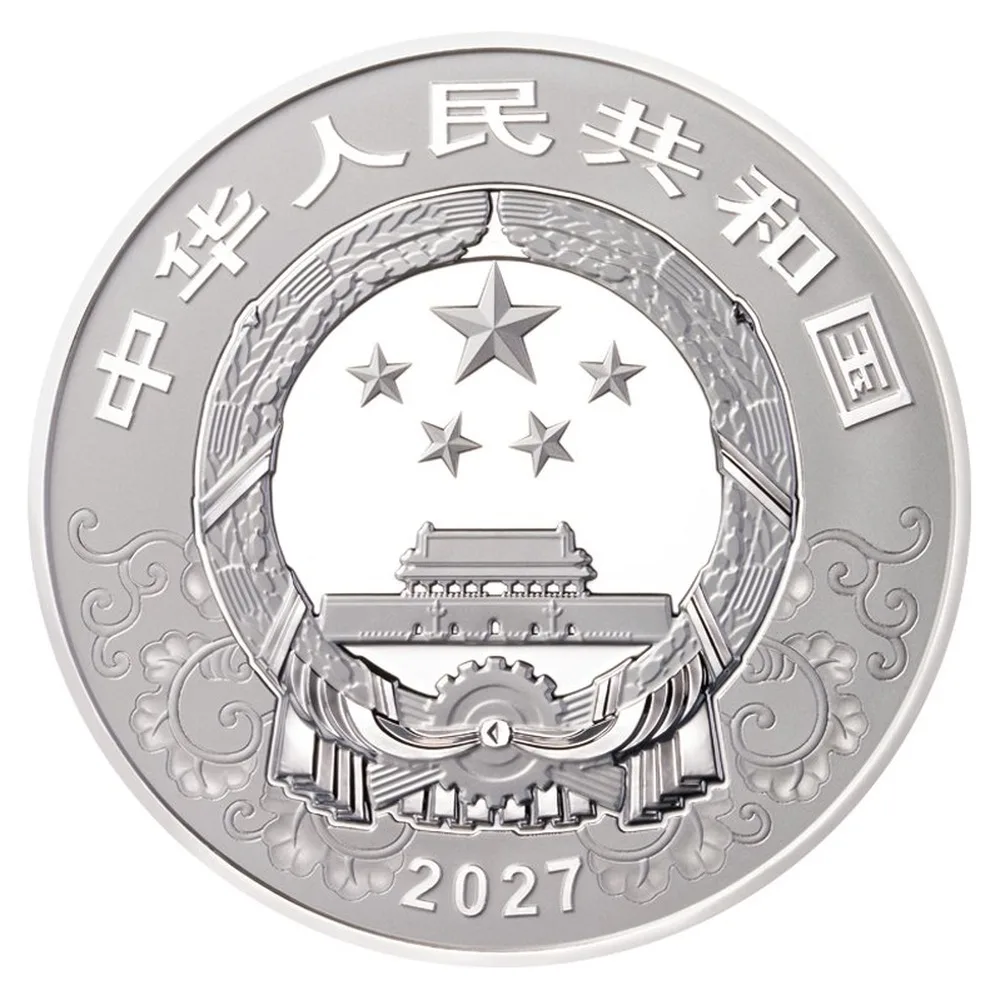
The official side bears the national emblem of the PRC, surrounded by traditional auspicious patterns. The name of the country, 中华人民共和国 (Zhonghua Renmin Gongheguo), and the year 2027 are given here as well. The austere, recognisable look of the obverse stays classical, and it is against this background that the technological reverse looks especially striking: the official side keeps the link with tradition, and the reverse rethinks that link.
Reverse
The pictorial side shows a mechanical ram's head. Its field is filled with an electrical circuit: printed-circuit tracks, contacts and microchip nodes form the background and flow into the drawing of the head itself. The inscription 丁未 (Ding-wei) marks the year. The meaning of the work lies in the collision of two eras: an ancient zodiac sign and modern electronics. The style is deliberately iron-like, almost robotic, yet the symmetry and the silhouette remain recognisably zodiacal.